
Documents Every Traveler Should Carry

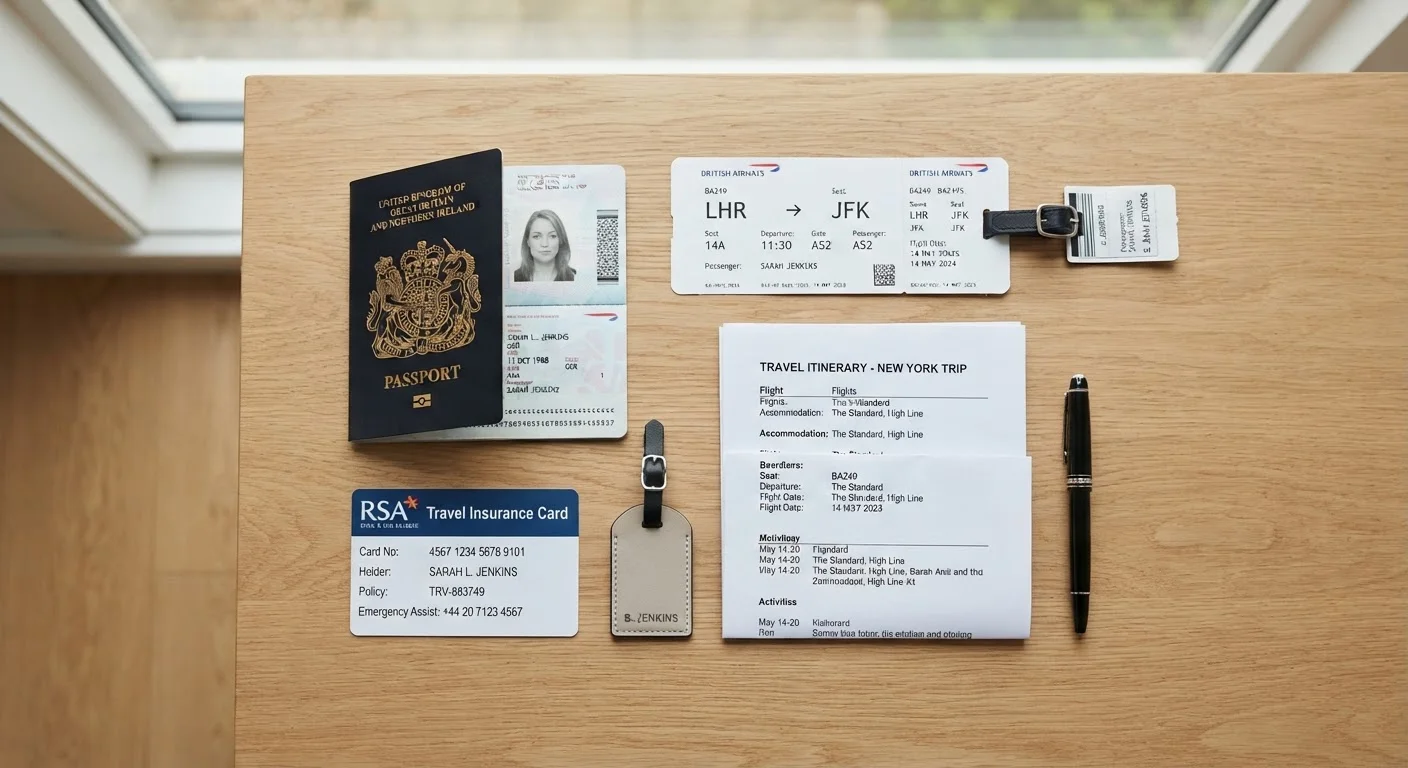
Photo: QuickSearches.net | It Doesn't Get Quicker Than This! editorial
Why Your Document Checklist Matters More Than You Think
A missing document at the wrong moment - a border crossing, a car rental counter, a hospital abroad - can stall your trip or cost you real money. Yet most travelers spend more time packing clothes than organizing paperwork. This reference guide covers the core documents to have on hand for domestic and international travel, whether you're driving a few states over or flying to another country.
For a broader look at pre-departure logistics, see the pre-trip planning checklist that covers bookings, fees, and contingencies in one place.
| Passport validity buffer | At least 6 months beyond return date (Standard requirement for many international destinations) |
| REAL ID required for domestic flights | Yes - enforced at U.S. airport security (U.S. Department of Homeland Security) |
| IDP availability | Must be obtained in the U.S. before departure (AAA and AATA are the two U.S.-authorized IDP issuers) |
| Countries recognizing IDP | 150+ (Based on 1949 Geneva Convention on Road Traffic signatories) |
| Documents to store digitally | Passport, insurance cards, visa, booking confirmations |
| Emergency contacts | Keep written on paper - don't rely on phone alone |
Identity and Entry Documents
These are non-negotiable - you either have them or you're not getting through.
- Passport: Required for all international air travel from the U.S. Check that yours is valid for at least six months beyond your return date - many countries enforce this rule strictly.
- Passport card: Valid for land and sea crossings between the U.S., Canada, Mexico, the Caribbean, and Bermuda. Cheaper and more compact than a full passport book.
- REAL ID-compliant driver's license or state ID: Required for domestic flights when boarding at U.S. airports. Check with the TSA or your state's DMV if you're unsure whether your current ID qualifies.
- Visa (if applicable): Many countries require a visa before arrival. Requirements vary widely. Always verify current entry requirements through official government sources well before you travel. The entry requirements guide breaks down how to read visa and customs rules without confusion.
- Vaccination records or health certificates: Some destinations require proof of specific vaccinations. Requirements change; verify with the destination country's official entry portal and the CDC before departure.
Travel, Insurance, and Financial Documents
These documents protect your money and your options if things go sideways.
- Travel insurance policy summary: Carry the one-page summary or card showing your policy number, coverage limits, and the 24-hour emergency assistance number. Don't bury this in email - you may need it when you don't have reliable internet access.
- Health insurance card: Domestic plans often have limited or no international coverage, but you'll still need it for any U.S.-based care before or after your trip. If you're traveling with a chronic condition, see the chronic condition travel guide for documentation specific to ongoing medical needs.
- Emergency contact information: Write this down on paper. Phone batteries die and screens crack.
- Bank and credit card contact numbers: The numbers on the back of your cards don't work from international lines. Look up the international collect or direct-dial numbers and keep them written separately.
- Booking confirmations: Hotels, flights, tours, and car rentals. Digital is fine, but a printed backup saves headaches during connectivity gaps. See how to keep trip details organized for practical systems.
REAL ID
A U.S. federal standard for state-issued driver's licenses and IDs that meet enhanced security requirements. As of the current federal mandate, a REAL ID-compliant card is required to board domestic flights and access certain federal facilities.
International Driving Permit (IDP)
A document that translates your valid U.S. driver's license into multiple languages, allowing you to drive legally in over 150 countries. It must be carried alongside your original license and cannot be obtained abroad.
Travel Insurance Policy Summary
A condensed version of your travel insurance policy showing key coverage details, policy number, and emergency contact numbers. This is the document you need accessible during a trip - not the full multi-page policy.
Visa
An official authorization - typically a stamp or document - that permits a traveler to enter, stay in, or pass through a foreign country for a specified period and purpose. Requirements vary by destination and traveler nationality.
Passport Validity Rule
A requirement enforced by many countries that your passport must remain valid for at least six months beyond your planned return date. Travelers with passports expiring sooner may be denied boarding or entry.
Driving and Vehicle-Specific Documents
If any part of your trip involves driving - a rental, a road trip, or crossing a border by car - you need these.
- Driver's license: Your valid U.S. driver's license covers you domestically. For international driving, many countries also accept it, but some require an IDP alongside it.
- International Driving Permit (IDP): A translated companion to your license, recognized in over 150 countries. Obtain one before leaving the U.S. - you cannot get one abroad. Visit the driving and safety hub for more on road preparedness.
- Rental agreement: Keep the full printed or digital copy in the vehicle. It includes your coverage details and roadside assistance contacts.
- Vehicle registration and proof of insurance: Required if you're driving your own car. For cross-border drives into Mexico or Canada, check whether your U.S. auto insurance extends there - many policies don't, and you may need a separate policy.
Digital Copies: A Backup, Not a Replacement
Storing scanned copies of your passport, insurance cards, and visa in a secure cloud folder or encrypted app gives you a recovery option if originals are lost or stolen. Email yourself copies as a secondary backup. That said, digital-only won't satisfy every checkpoint or emergency room intake desk - physical documents still carry authority that a phone screen doesn't always replicate.
For a detailed comparison of both strategies, the digital vs. physical document guide walks through when each format matters most.
Before any trip, run through the pre-trip preparation checklist to confirm nothing has slipped through the cracks. A few minutes of organization before departure is worth hours of stress at a foreign consulate.
Entry requirements, visa rules, and vaccination mandates change frequently. Always verify current requirements with official government sources - including the U.S. Department of State and the relevant destination country's embassy or consulate - before traveling.
The content on this site is provided for informational purposes only and should not be considered a substitute for professional advice. While we strive to provide accurate and up-to-date information, we make no guarantees regarding its completeness or accuracy. Always consult a qualified professional for advice specific to your circumstances before making any decisions