
Road Signs Decoded: A Field Guide for Everyday Drivers

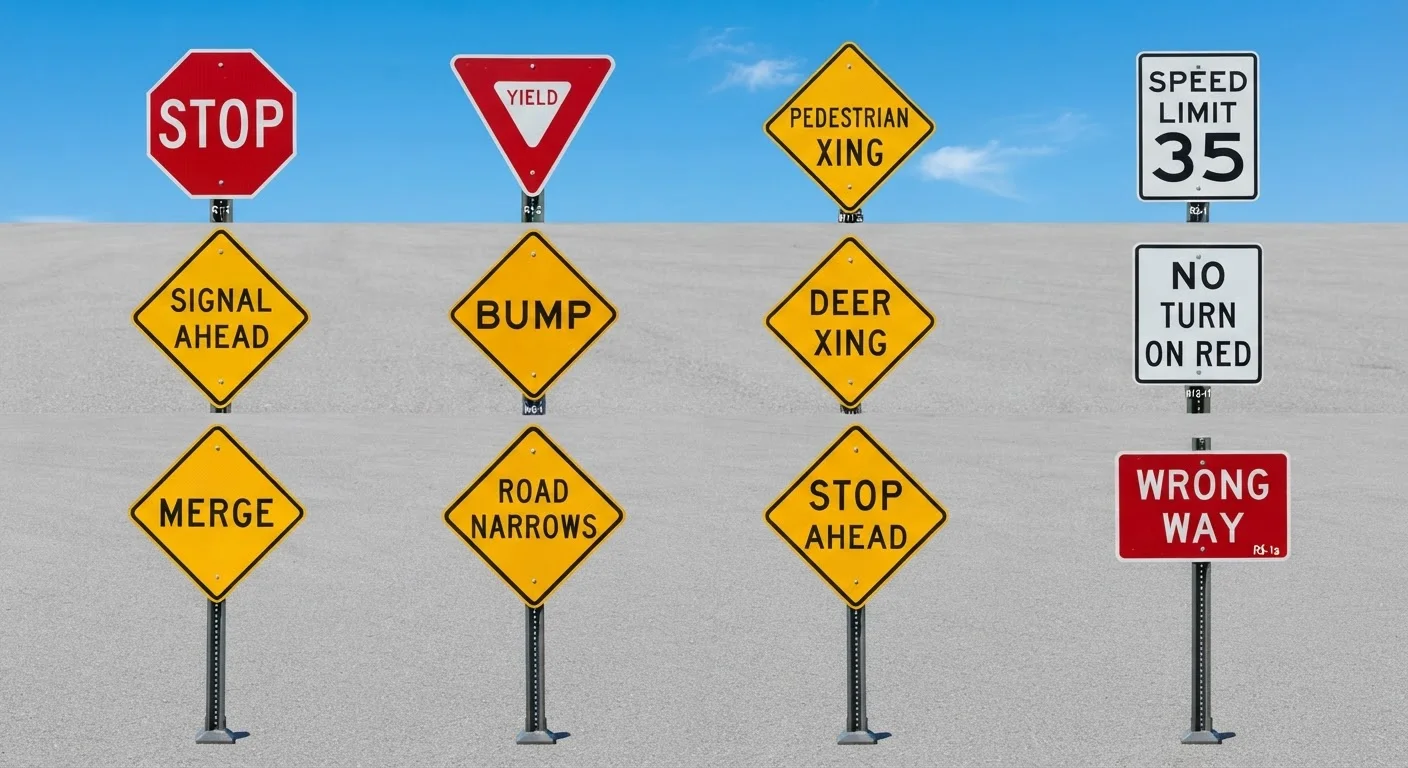
Photo: QuickSearches.net | It Doesn't Get Quicker Than This! editorial
Why Shape and Color Come Before Words
Every U.S. road sign is engineered so a driver can grasp its category before reading a single letter. The Federal Highway Administration's MUTCD standardizes sign shapes and colors nationwide, so the system works even when a sign is partially obscured or a driver is too far away to read text.
Shape conveys legal authority at a glance. An eight-sided sign always means stop. A triangle pointing down always means yield. A diamond always signals a warning. Pentagons mark school zones; circles indicate railroad crossings. Colors layer on additional meaning: red signals prohibition or danger, yellow signals general warning, orange marks work zones, green gives directional guidance, and blue indicates services such as fuel or hospitals.
For a deeper look at how these fundamentals connect to specific laws, see traffic laws Americans routinely misunderstand.
| Governing Standard | MUTCD (Manual on Uniform Traffic Control Devices) (Federal Highway Administration) |
| Stop Sign Shape | Octagon (8 sides) |
| Warning Sign Shape | Diamond |
| Work Zone Sign Color | Orange |
| School Zone Sign Shape | Pentagon (5 sides) |
| Railroad Crossing Sign Shape | Circle |
The Three Major Sign Categories
Regulatory Signs
Regulatory signs carry the force of law. Ignoring them can result in citations, points on a license, or worse. Common examples include speed limit signs (white rectangle with black text), no-turn signs (red circle with a slash), and do-not-enter signs (red rectangle with a white horizontal bar). Stop and yield signs also fall in this category despite their distinctive shapes.
Warning Signs
Yellow diamond-shaped signs alert drivers to upcoming hazards - sharp curves, merging lanes, pedestrian crossings, low clearances, or slippery surfaces. These signs do not mandate a specific action but signal that extra caution is warranted. Orange diamonds serve the same function specifically inside construction and maintenance zones, where fines are often doubled by state law.
Guide and Informational Signs
Green signs with white text provide route numbers and distances. Blue signs point to services. Brown signs mark parks, historical sites, and recreational areas. These signs help drivers navigate without creating legal obligations, though missing an exit or turn because of them can lead to unsafe maneuvers - a risk discussed in rural vs. urban driving demands.
MUTCD
The Manual on Uniform Traffic Control Devices, published by the Federal Highway Administration, sets the national standard for all road signs, pavement markings, and signals in the United States.
Regulatory Sign
A sign that conveys a traffic law or regulation drivers are legally required to obey, such as speed limits, stop signs, and no-turn restrictions.
Warning Sign
A sign - typically a yellow or orange diamond - that alerts drivers to a hazard or change in road conditions ahead, calling for increased attention rather than a specific legal action.
Variable Message Sign
An electronic overhead sign capable of displaying changing information such as current speed limits, incident warnings, or travel times. When displaying regulatory content, it carries the same legal weight as a static sign.
Work Zone
A designated area where road construction or maintenance is actively occurring, marked by orange signs and cones. Many states impose higher fines for moving violations within work zones.
Symbols, Arrows, and Temporary Conditions
Text-free symbol signs are increasingly common because they communicate faster and work for non-English readers. A bicycle silhouette marks a bike lane; a walking figure marks a pedestrian crossing; an arrow with a curve signals a winding road ahead. When in doubt, the shape and color still provide the category, and context - school zone, highway on-ramp, construction corridor - narrows the meaning further.
Temporary signs deserve special attention. Flashing yellow beacons above pedestrian or school-zone signs indicate that pedestrian right-of-way rules are currently active. Variable message signs (electronic boards) over highways can shift speed limits or warn of incidents in real time - treat them as binding regulatory signs, not suggestions.
Seasonal changes also affect sign interpretation. Snow can bury pavement markings or obscure low-mounted signs, making the shape-and-color system even more critical. Review seasonal driving preparedness to understand how conditions alter what signs you need to watch for most carefully.
This article presents general educational information about U.S. road sign standards. Traffic laws and local regulations vary by state and municipality. Always consult your state's driver handbook or a qualified legal resource for guidance specific to your jurisdiction.
The content on this site is provided for informational purposes only and should not be considered a substitute for professional advice. While we strive to provide accurate and up-to-date information, we make no guarantees regarding its completeness or accuracy. Always consult a qualified professional for advice specific to your circumstances before making any decisions