
Following Distance: The Gap Between You and a Collision

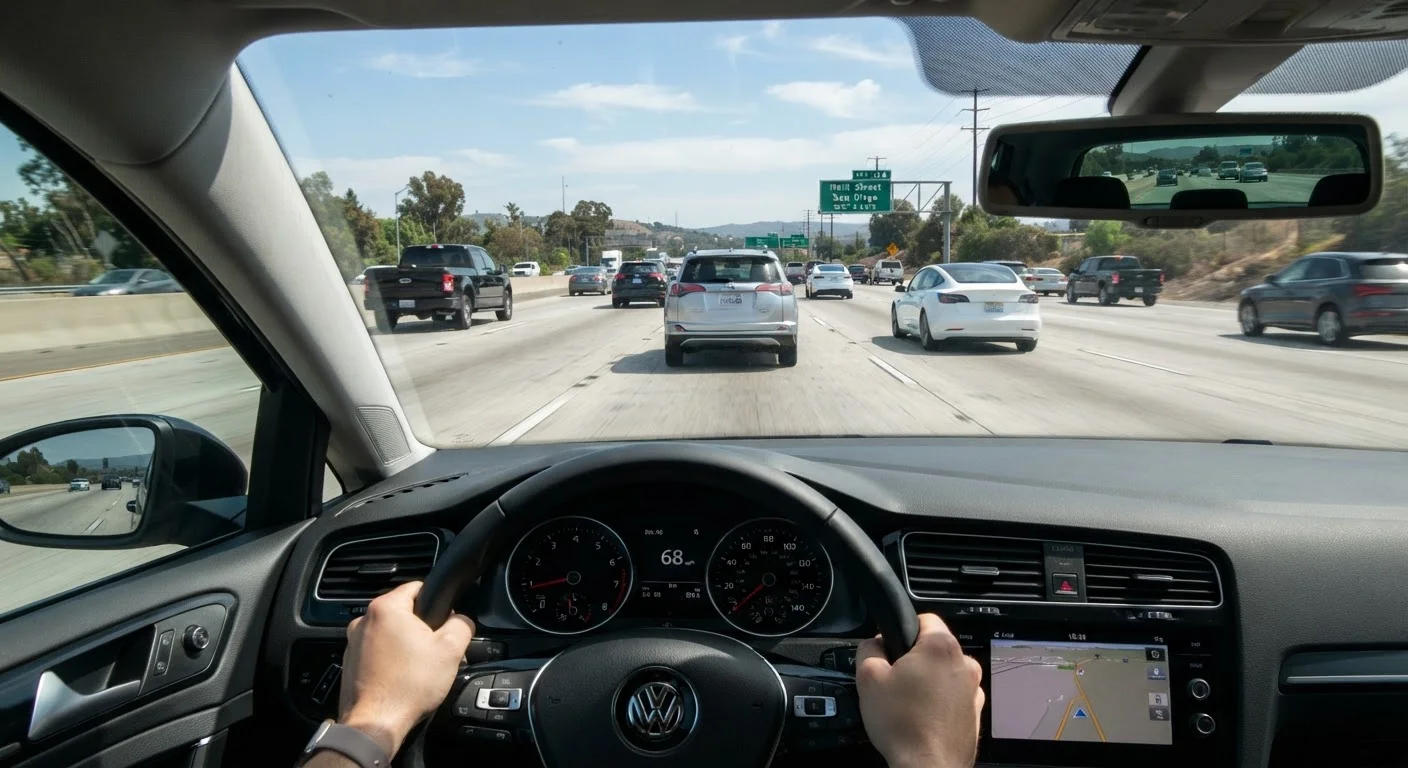
Photo: QuickSearches.net | It Doesn't Get Quicker Than This! editorial
Key Takeaways
- Following distance is measured in seconds, not car lengths, making it accurate at any speed.
- The 3-second rule is the minimum safe gap in dry, ideal conditions.
- Reaction time alone - before braking even begins - typically consumes 1 to 1.5 seconds.
- Rain, ice, fog, fatigue, and heavy loads all require you to increase your gap significantly.
- Rear-end collisions are among the most common crash types in the U.S., and most are preventable.
- Tailgating the driver in front rarely saves meaningful travel time but sharply raises crash risk.
Why the Gap in Front of You Is Your Safety Margin
Every moment you spend behind the wheel, the space between your car and the one ahead is quietly doing critical work. That gap is the only buffer available when the unexpected happens - a sudden brake, a blown tire, a child running into the road. When that buffer disappears, so does your ability to avoid a crash.
Rear-end collisions consistently rank among the most frequent crash types on American roads, according to federal traffic safety data. The majority involve a driver following too closely to stop in time. What makes this especially preventable is that following distance is entirely within your control, costs nothing, and requires only a small habit adjustment.
The challenge is that human judgment of distance at speed is notoriously unreliable. A gap that feels comfortable at 30 mph is dangerously thin at 60 mph. That is why safety professionals shifted from counting car lengths to counting time - the 3-second rule applies equally whether you are in a school zone or on the interstate.
~29%
Share of crashes involving rear-end collisions
According to the National Highway Traffic Safety Administration (NHTSA), rear-end crashes represent a substantial portion of all reported traffic collisions in the U.S.
1-1.5 sec
Typical driver reaction time before braking
Traffic safety research consistently finds that an alert driver takes between 1 and 1.5 seconds to perceive a hazard and begin applying the brakes - time during which the vehicle continues at full speed.
4×
Stopping distance increase on icy roads
The Federal Highway Administration notes that stopping distances on ice can be four times greater than on dry pavement, underscoring why gap adjustments in winter conditions are critical.
How to Actually Measure Your Following Distance
The 3-second rule is straightforward in practice. Pick any stationary roadside reference point - a lane marker, overpass, or sign. The moment the rear bumper of the vehicle ahead crosses that point, start counting: one-one-thousand, two-one-thousand, three-one-thousand. If your front bumper reaches that same point before you finish, you are too close.
At 30 mph, 3 seconds translates to roughly 130 feet of space. At 60 mph, that same 3 seconds covers approximately 264 feet. The time stays fixed; the physical distance grows with speed - which is exactly why the time-based method is so useful.
This minimum assumes ideal conditions: dry pavement, full alertness, and a vehicle in good mechanical shape. In the real world, most drivers should treat 3 seconds as a floor, not a target.
Practice the Count in Low-Traffic Conditions
When You Need to Add More Space
Several conditions demand that you extend well beyond 3 seconds:
- Wet or icy roads: Water reduces tire grip substantially; ice can reduce it to near zero. A 4-6 second gap in rain and 8 or more seconds on ice or snow is widely recommended by traffic safety authorities.
- Reduced visibility: Fog, heavy rain, glare, and nighttime conditions slow your ability to perceive hazards. Extra distance compensates for delayed recognition.
- Towing or heavy loads: Additional weight dramatically increases stopping distance. A vehicle towing a trailer or carrying a full truck bed needs significantly more room to slow safely.
- Fatigue or distraction: Reaction times of 1 to 1.5 seconds assume full alertness. Tired or distracted drivers react slower, consuming your safety margin before braking even begins.
- Following large vehicles: Trucks and buses block your sightlines. A larger gap lets you see further ahead and gives you more warning of developing hazards.
Understanding these adjustments is a core element of defensive driving - anticipating conditions rather than reacting to them at the last moment.
The Tailgating Trap: Why Drivers Follow Too Closely
Most tailgating is not malicious - it is habitual. Drivers unconsciously drift closer to the vehicle ahead, especially in heavy traffic where the gap keeps getting filled. Impatience and time pressure lead some drivers to follow closely under the mistaken belief it will meaningfully speed up their trip. Research on traffic flow suggests the opposite: tailgating contributes to stop-and-go waves that slow everyone down.
Aggressive close-following is a different matter. It often starts as frustration and can escalate quickly. The vehicle behind you has no obligation to accelerate, and pressuring another driver rarely produces the result you want. For more on how this dynamic can spiral, see our article on why aggressive driving escalates faster than drivers expect.
Modern vehicles equipped with automatic emergency braking can help in some rear-end scenarios, but these systems are not a substitute for attentive driving and have real-world limitations. No technology closes the gap as reliably as the driver who chooses not to tailgate in the first place.
Frequently Asked Questions
The content on this site is provided for informational purposes only and should not be considered a substitute for professional advice. While we strive to provide accurate and up-to-date information, we make no guarantees regarding its completeness or accuracy. Always consult a qualified professional for advice specific to your circumstances before making any decisions