
Fixed Wireless vs. DSL: Which Makes More Sense in Areas Without Fiber or Cable?

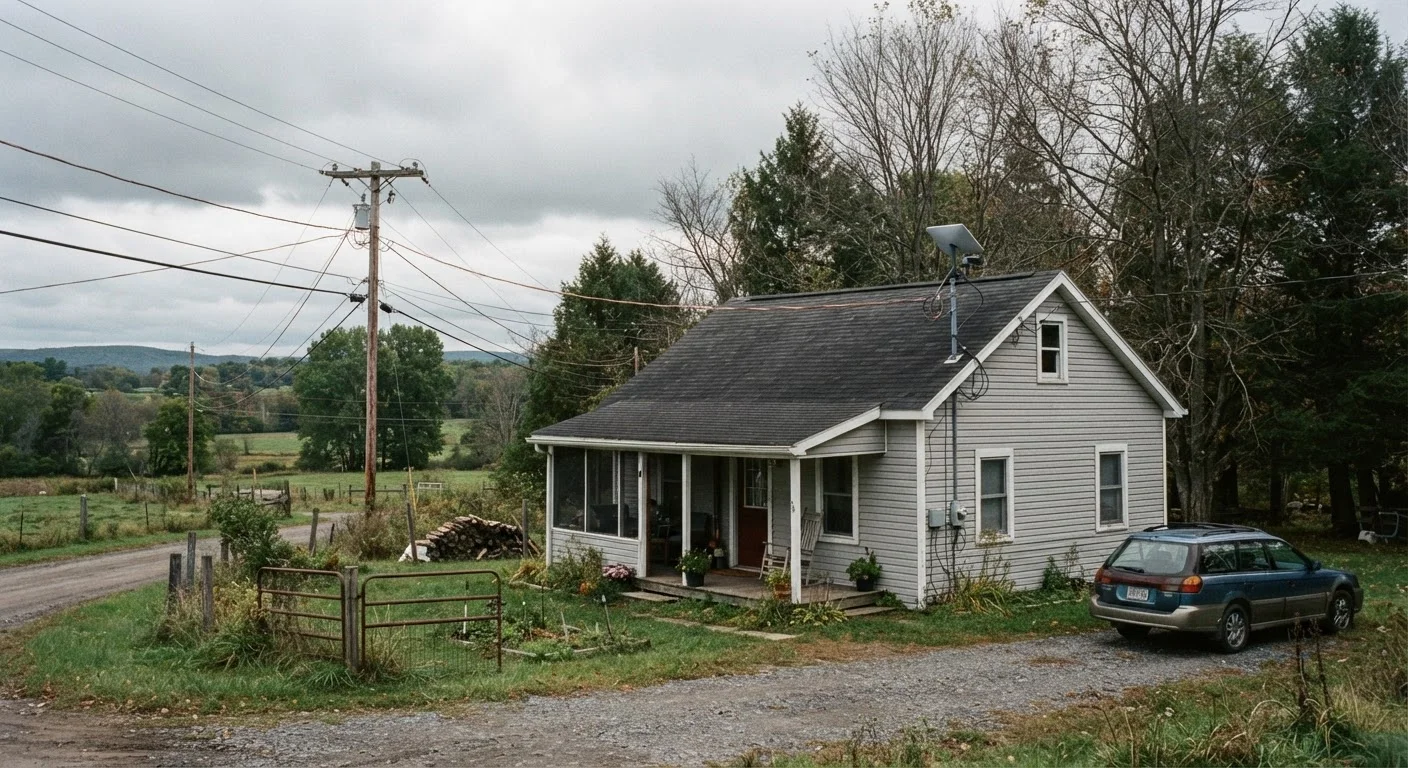
Photo: QuickSearches.net | It Doesn't Get Quicker Than This! editorial
Key Takeaways
- Fixed wireless typically delivers faster speeds than DSL, often reaching 25-100+ Mbps depending on tower proximity.
- DSL availability is broader in rural areas because it runs on existing telephone copper lines.
- Fixed wireless performance can degrade with distance from the tower and during peak network hours.
- DSL speeds decline sharply the farther your home sits from the provider's central office.
- Neither technology matches fiber or cable for raw performance, but both can support everyday household use.
- Availability in your specific address - not general reputation - is the deciding factor for most households.
How Each Technology Actually Works
Understanding the basics helps you predict how each service will behave in your home - not just on paper.
Fixed wireless internet transmits data over radio signals between a provider's tower and a small antenna installed at your home. That antenna connects to a router inside your house, delivering broadband without any buried cable. Because it's wireless, the signal quality depends heavily on your distance from the tower, the presence of trees or terrain obstacles, and how many subscribers share the tower's capacity.
DSL (Digital Subscriber Line) carries internet service over the same copper telephone wires that already run to most American homes. Your modem connects to that existing phone jack and communicates with a provider's central office - the physical facility housing the equipment that links your home to the broader internet. DSL doesn't require line-of-sight or a tower, but its speed is directly tied to how far your home sits from that central office. The longer the copper run, the slower the connection.
For a broader look at how these compare to the options most urban households take for granted, see how fiber and cable stack up.
Speed, Reliability, and Real-World Performance
On paper, fixed wireless has a clear speed advantage. Many fixed wireless providers advertise download speeds between 25 Mbps and 100 Mbps, with some newer networks - particularly those built on 4G LTE or 5G infrastructure - reaching higher tiers. DSL plans in rural areas commonly top out between 10 Mbps and 25 Mbps, and real-world speeds can fall well short of those figures depending on line quality.
| Criterion | Fixed Wireless | DSL |
|---|---|---|
| Typical download speed range | 25-100+ Mbps | 5-25 Mbps (varies with distance) |
| Infrastructure dependency | Requires nearby tower with line-of-sight | Requires active phone line to home |
| Speed degradation factor | Distance from tower; peak congestion | Distance from provider's central office |
| Weather sensitivity | Moderate (heavy rain, dense foliage) | Low (but copper degrades over time) |
| Upload speeds | Generally more balanced | Often significantly lower than download |
| Installation complexity | Technician required for antenna mount | Often self-install via existing phone jack |
| Geographic availability | Expanding but still patchy in rural areas | Broad - follows telephone network coverage |
Reliability is more nuanced. DSL is a dedicated connection to your home - you're not sharing bandwidth with neighbors in the same way. Fixed wireless, by contrast, shares tower capacity across all connected subscribers in the area, which can mean slower speeds during evening peak hours. Heavy rain or dense foliage can also interfere with the wireless signal, though modern equipment has reduced this sensitivity.
DSL's copper lines are vulnerable to corrosion and degradation over time, and older infrastructure in rural areas may not have been well maintained. That can introduce intermittent outages that are difficult to diagnose.
~25 Mbps
FCC minimum broadband speed threshold
The FCC defines broadband as 25 Mbps download / 3 Mbps upload - a benchmark many rural DSL connections still fall short of.
~21 million
Americans lacking fixed broadband access
FCC estimates have placed tens of millions of Americans without access to fixed broadband meeting the 25/3 Mbps standard, with rural areas disproportionately affected.
Up to 50%
DSL speed loss over long copper runs
Industry analyses suggest DSL speeds can drop by half or more when a home is located several miles from the provider's central office equipment.
Availability: The Factor That May Decide for You
No comparison of speeds or pricing matters if one option simply isn't available at your address. This is the single most important thing to verify before weighing any other factor.
DSL reaches a larger geographic footprint because it piggybacks on decades of telephone infrastructure. Most US homes that have an active phone line can theoretically receive DSL. Fixed wireless coverage depends on tower placement, and while cellular carriers have expanded rural networks, gaps remain - particularly in mountainous or heavily forested areas where signals don't travel cleanly.
That said, fixed wireless coverage has grown significantly in recent years as providers have invested in rural broadband. The FCC's National Broadband Map and individual provider coverage tools are reasonable starting points, though on-the-ground availability sometimes differs from mapped estimates. Contacting local providers directly and asking neighbors about their actual service experience remains one of the most reliable ways to assess what's genuinely accessible at a specific address.
If neither fixed wireless nor DSL delivers acceptable service at your location, satellite internet may be the only remaining option - though it comes with its own trade-offs around latency and data limits.
Cost, Equipment, and Practical Setup
Pricing for both technologies varies by region and provider, so specific figures here would go stale quickly. That said, some general patterns hold across the market.
DSL plans have historically been available at lower monthly rates than fixed wireless, partly because providers amortized infrastructure costs over many years. However, fixed wireless pricing has become more competitive as the technology has matured and more providers have entered the market. Equipment costs - modems for DSL, and an outdoor antenna plus router for fixed wireless - are typically provided by the ISP on a rental basis or available for one-time purchase.
Fixed wireless installation usually requires a technician to mount and aim the antenna, which takes a few hours. DSL activation often involves simpler self-installation using existing phone wiring, though a technician visit may be needed to check line quality. Both services commonly involve one- or two-year contracts, though month-to-month options exist.
Once you've chosen a service, practical steps to maximize your connection's reliability - like router placement and firmware updates - apply equally to both technologies. For a comprehensive overview of how internet pricing and contracts work generally, see the full picture on home internet.
The content on this site is provided for informational purposes only and should not be considered a substitute for professional advice. While we strive to provide accurate and up-to-date information, we make no guarantees regarding its completeness or accuracy. Always consult a qualified professional for advice specific to your circumstances before making any decisions