
Renting vs. Buying a Home: A Balanced Look at the Trade-Offs

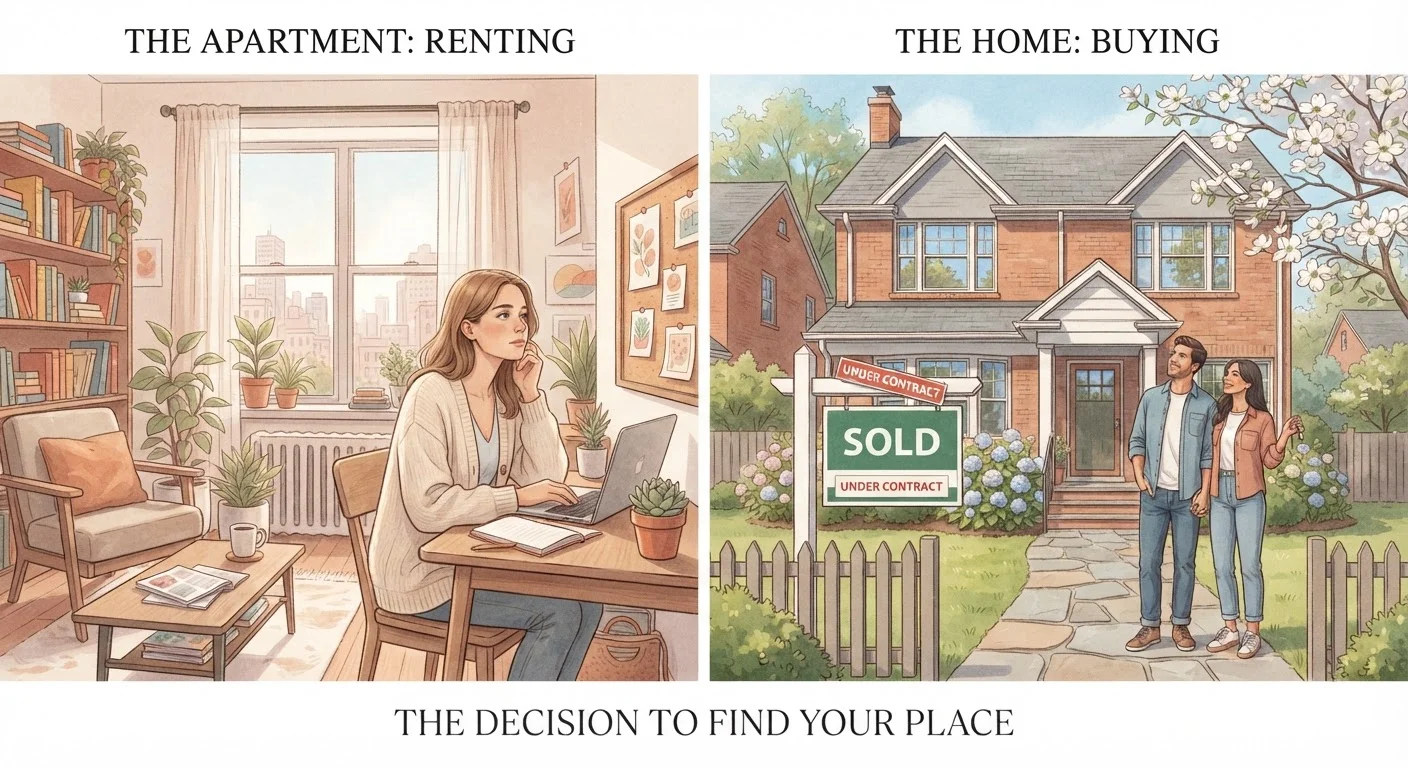
Photo: QuickSearches.net | It Doesn't Get Quicker Than This! editorial
Key Takeaways
- Buying builds equity over time, but upfront costs and ongoing expenses are substantial.
- Renting offers flexibility and lower short-term financial commitment, but no ownership stake.
- The financial case for buying generally strengthens the longer you plan to stay in one place.
- Hidden costs on both sides - maintenance, fees, rent increases - can shift the math significantly.
- Personal circumstances, job stability, and local market conditions matter as much as mortgage rates.
Builds equity and long-term wealth
Each mortgage payment gradually increases your ownership stake in the property. Over time, rising home values can meaningfully grow your net worth, something renting cannot replicate.
Predictable costs with a fixed-rate mortgage
A fixed-rate mortgage locks in your principal and interest payment for the life of the loan. Unlike renting, you won't face sudden, landlord-imposed payment increases.
Freedom to customize your living space
Homeowners can renovate, paint, landscape, or make structural changes without seeking permission. This level of control is rarely available to renters.
Potential tax advantages
Homeowners may be able to deduct mortgage interest and property taxes from their federal taxable income, depending on whether they itemize deductions. Consult a tax professional for guidance specific to your situation.
Stability and community roots
Owning a home typically encourages longer stays, which can strengthen neighborhood ties, school continuity for children, and a deeper sense of belonging.
Large upfront costs create a high barrier
Down payments commonly range from 3% to 20% of the purchase price, plus closing costs of 2%-5%. On a $350,000 home, that's potentially $10,500 to $87,500 before moving in.
Maintenance and repairs fall on you
Homeowners are responsible for every repair, from a leaky roof to a failing HVAC system. Financial experts commonly suggest budgeting 1%-2% of the home's value annually for maintenance.
Reduced flexibility to relocate
Selling a home takes time and involves transaction costs - typically 6%-10% of the sale price. If your job or life plans shift unexpectedly, ownership can become a constraint.
Market value can decline
Home prices do not always rise. Buyers who purchase near a market peak can find themselves owing more than the home is worth if values fall - a situation known as being underwater.
Property taxes and insurance add ongoing costs
Beyond the mortgage, homeowners pay property taxes, homeowners insurance, and potentially HOA fees. These costs vary widely by location and can add thousands of dollars annually.
Why This Decision Deserves Careful Thought
The cultural narrative in the United States has long treated homeownership as the default sign of financial maturity. But the reality is more nuanced. Whether buying or renting makes more sense depends heavily on your personal finances, life stage, local market, and how long you intend to stay in one place.
This article lays out the concrete trade-offs on both sides - not to push you in one direction, but to help you evaluate the decision against your own circumstances. For a deeper look at costs that standard calculators miss, see our financial trade-offs beyond the calculator.
The Break-Even Horizon Matters Most
The Case for Buying a Home
Purchasing a home offers advantages that renting fundamentally cannot match - primarily the ability to build equity.
Builds equity and long-term wealth
Each mortgage payment gradually increases your ownership stake in the property. Over time, rising home values can meaningfully grow your net worth, something renting cannot replicate.
Predictable costs with a fixed-rate mortgage
A fixed-rate mortgage locks in your principal and interest payment for the life of the loan. Unlike renting, you won't face sudden, landlord-imposed payment increases.
Freedom to customize your living space
Homeowners can renovate, paint, landscape, or make structural changes without seeking permission. This level of control is rarely available to renters.
Potential tax advantages
Homeowners may be able to deduct mortgage interest and property taxes from their federal taxable income, depending on whether they itemize deductions. Consult a tax professional for guidance specific to your situation.
Stability and community roots
Owning a home typically encourages longer stays, which can strengthen neighborhood ties, school continuity for children, and a deeper sense of belonging.
That said, buying is not automatically a financial win. The benefits above are most pronounced when buyers stay long enough to recoup transaction costs and when the local market supports stable or appreciating values. See what to expect after closing in our Owning a Home hub.
The Real Costs of Homeownership
Ownership costs extend well beyond the monthly mortgage payment, and first-time buyers are often caught off guard by how quickly they accumulate.
~5-7 years
Minimum stay to break even on buying
Real estate economists generally estimate that buyers need to stay in a home for at least five to seven years before the cost of ownership outweighs the transaction and opportunity costs of purchasing.
1%-2%
Annual home maintenance cost estimate
A widely cited rule of thumb suggests homeowners budget 1%-2% of their home's value each year for routine maintenance and unexpected repairs.
2%-5%
Typical closing cost range for buyers
According to the Consumer Financial Protection Bureau, buyers generally pay closing costs equal to 2%-5% of the loan amount, covering fees for appraisals, title insurance, and lender charges.
Property taxes, homeowners insurance, and HOA fees (where applicable) can add $3,000-$10,000 or more annually depending on where you live. Our article on the real cost of owning a home breaks these down in detail. It's also worth having a dedicated emergency fund sized for homeowners - the math changes meaningfully once you own.
The Case for Renting
Renting is not a financial failure - it's a rational choice under a wide range of circumstances.
- Lower upfront commitment: No down payment or closing costs means you keep capital available for other uses or investment.
- Flexibility to relocate: Month-to-month or annual leases allow you to move for jobs, relationships, or lifestyle changes without the friction of a home sale.
- Predictable repair exposure: When something breaks, the landlord - not you - is typically responsible for fixing it.
- Ability to live in high-cost areas: In cities where purchase prices are extremely high relative to incomes, renting can be the only practical option even for financially stable adults.
Renters should still go in with eyes open. Our guide on hidden costs of renting covers fees and expenses that often surprise first-time tenants.
The Drawbacks of Renting
Renting comes with its own set of genuine limitations.
Large upfront costs create a high barrier
Down payments commonly range from 3% to 20% of the purchase price, plus closing costs of 2%-5%. On a $350,000 home, that's potentially $10,500 to $87,500 before moving in.
Maintenance and repairs fall on you
Homeowners are responsible for every repair, from a leaky roof to a failing HVAC system. Financial experts commonly suggest budgeting 1%-2% of the home's value annually for maintenance.
Reduced flexibility to relocate
Selling a home takes time and involves transaction costs - typically 6%-10% of the sale price. If your job or life plans shift unexpectedly, ownership can become a constraint.
Market value can decline
Home prices do not always rise. Buyers who purchase near a market peak can find themselves owing more than the home is worth if values fall - a situation known as being underwater.
Property taxes and insurance add ongoing costs
Beyond the mortgage, homeowners pay property taxes, homeowners insurance, and potentially HOA fees. These costs vary widely by location and can add thousands of dollars annually.
Rent increases are among the most significant long-term risks for tenants. Understanding your rights is important - our article on what landlords can and cannot do with rent increases explains what protections may apply in your area.
How to Think Through the Decision
There is no universal formula, but a few questions can sharpen your thinking:
- How long will you stay? Buyers who move within three years rarely recoup purchasing costs. Five to seven years is generally considered the minimum horizon for buying to make financial sense.
- What are the local price-to-rent ratios? In markets where home prices are very high relative to rents, renting and investing the difference can outperform buying - at least in the short to medium term.
- Is your income stable? A mortgage is a fixed obligation. Job uncertainty significantly changes the risk profile of ownership.
- Do you have adequate reserves? Beyond a down payment, buyers need funds for closing costs, an emergency reserve, and early maintenance surprises.
If you're leaning toward buying, understanding your financing options is a critical next step. Our guide to fixed-rate vs. adjustable-rate mortgages and overview of government-backed loan programs can help you understand what financing structures are available. Working with a professional also matters - learn what a buyer's agent actually does before you commit to one.
This article is for general informational purposes only and does not constitute financial, legal, or investment advice. Consult a qualified financial adviser or real estate professional regarding decisions specific to your situation.
The content on this site is provided for informational purposes only and should not be considered a substitute for professional advice. While we strive to provide accurate and up-to-date information, we make no guarantees regarding its completeness or accuracy. Always consult a qualified professional for advice specific to your circumstances before making any decisions