
Common Fitness Metrics Decoded: Reps, Sets, RPE, and More

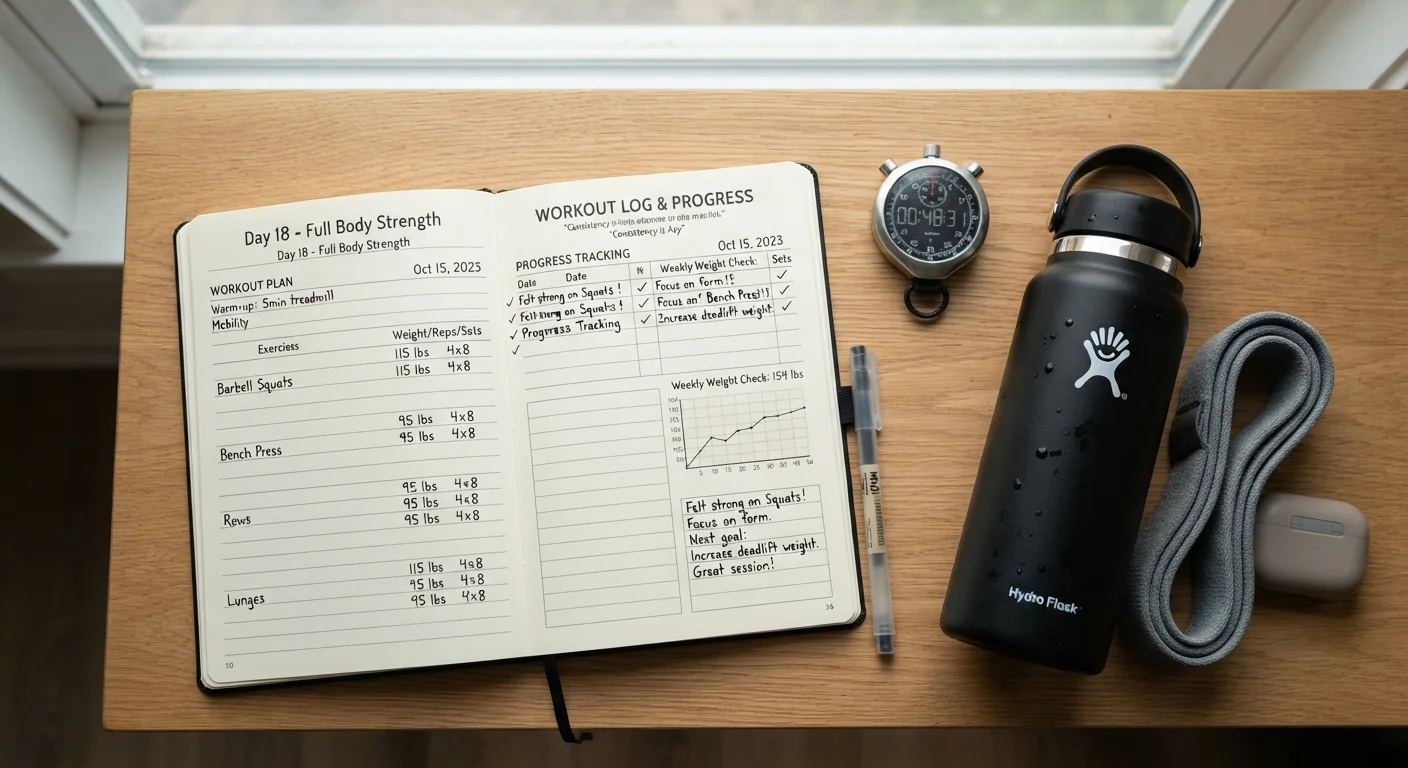
Photo: QuickSearches.net | It Doesn't Get Quicker Than This! editorial
Why Fitness Numbers Matter
Pick up almost any workout plan and you'll encounter a shorthand that can feel like a foreign language - "3x10 at 70% 1RM," "RPE 7," or "90-second rest intervals." These aren't arbitrary codes. Each metric gives you precise, repeatable instructions that help you train consistently and track progress over time.
This reference breaks down the most common fitness metrics you'll encounter, explaining what each one means and why it's there. Whether you're following a program from a trainer or building your own routine, understanding these terms puts you in control. For a broader look at how environment shapes your training choices, see our comparison of home and gym workouts.
Repetition (Rep)
One complete execution of an exercise movement from start to finish and back again. Rep ranges signal a training goal: low reps for strength, moderate for hypertrophy, high for endurance.
Set
A group of consecutive repetitions performed without stopping to rest. Programs typically prescribe multiple sets per exercise to accumulate sufficient training volume.
One-Rep Max (1RM)
The maximum weight an individual can lift for a single full repetition with proper form. Used as a reference point for prescribing percentage-based training loads.
Rate of Perceived Exertion (RPE)
A self-reported scale, usually 1-10, describing how hard an effort feels. Higher numbers indicate less remaining capacity; RPE 10 equals maximal effort with nothing left.
Reps in Reserve (RIR)
An estimate of how many additional reps you could perform before reaching technical failure. RIR 2 means you could do two more reps; it is roughly equivalent to RPE 8.
Progressive Overload
The principle of gradually increasing training demands - through load, volume, or intensity - so the body continues to adapt and improve over time.
Tempo
The prescribed speed of each phase of a lift, written as a four-digit code (e.g., 3-1-2-0) representing the eccentric, pause, concentric, and top-pause phases in seconds.
Volume
The total amount of work performed, commonly calculated as sets multiplied by reps multiplied by load. Managing volume is key to balancing stimulus and recovery.
Reps, Sets, and Volume: The Foundation
Almost every resistance or bodyweight program is built around three concepts: repetitions, sets, and total volume.
- Repetitions (reps): One complete movement - one squat, one push-up, one bicep curl. Rep ranges signal your training goal. Lower ranges (roughly 1-5) generally target maximal strength; moderate ranges (6-12) are associated with muscle growth (hypertrophy); higher ranges (15 or more) tend to emphasize muscular endurance.
- Sets: A group of consecutive reps performed without resting. Three sets of ten reps means you perform ten reps, rest, repeat that sequence three times total.
- Volume: The overall workload in a session or week, often calculated as sets × reps × load. More volume, over time, is one of the primary drivers of adaptation - but only when recovery is adequate.
These three variables are the levers you adjust when a program calls for progression. Increasing any one of them is a form of progressive overload - the principle that your body must face gradually increasing demands to continue improving. This idea is explored further in our guide to the FITT principle.
| Typical hypertrophy rep range | 6-12 reps per set (American College of Sports Medicine guidelines) |
| Strength-focused rep range | 1-5 reps per set (American College of Sports Medicine guidelines) |
| RPE scale range | 1 (minimal effort) to 10 (maximal) (Standard resistance training convention) |
| Rest for heavy compound lifts | 2-3 minutes between sets (National Strength and Conditioning Association) |
| Rest for lighter isolation work | 30-90 seconds between sets (National Strength and Conditioning Association) |
| Tempo notation format | 4 digits: eccentric-pause-concentric-top pause (Common strength programming convention) |
Intensity Metrics: 1RM, Percentages, and RPE
Knowing how heavy or hard to work is just as important as knowing how many times to do it. Three metrics govern intensity.
One-Rep Max (1RM) is the maximum weight you can lift for exactly one full repetition with good form. It's a benchmark. Most programs don't ask you to test it constantly; instead, they prescribe work at a percentage of your 1RM (e.g., "lift at 75% 1RM"), giving you a target load relative to your personal ceiling.
Rate of Perceived Exertion (RPE) is a self-reported scale - typically 1 to 10 - that describes how hard an effort feels. An RPE of 6 means you could keep going comfortably; an RPE of 9 means you have roughly one rep left in reserve. RPE is especially useful when you don't know your 1RM, when fatigue varies day to day, or when you train without access to heavy equipment.
Reps in Reserve (RIR) is the flip side of RPE - it counts how many reps you estimate you could still perform before failure. "2 RIR" and "RPE 8" communicate essentially the same effort level. Both tools help you train hard enough to stimulate adaptation without consistently pushing to technical failure, which increases injury risk.
This article provides general fitness education and is not a substitute for guidance from a qualified fitness or healthcare professional, especially if you have an existing health condition or injury.
Rest Periods, Tempo, and Reading a Full Program
Two metrics that are frequently overlooked - rest and tempo - have a meaningful impact on results.
Rest periods dictate how long you recover between sets. Shorter rests (30-60 seconds) maintain metabolic stress and cardiovascular demand. Longer rests (2-3 minutes or more) allow greater neuromuscular recovery, which supports heavier loads in subsequent sets. Skipping prescribed rest periods is one of the most common ways people unintentionally undercut their own program.
Tempo describes the speed of each phase of a movement, often written as a four-digit code such as 3-1-2-0. Reading left to right: the first number is the lowering (eccentric) phase in seconds, the second is the pause at the bottom, the third is the lifting (concentric) phase, and the fourth is the pause at the top. A slow eccentric increases time under tension, which can enhance muscle development even at lower loads.
When you understand these metrics together, a notation like "4x8 @ RPE 7, 3-1-2-0, 2-min rest" becomes a complete instruction rather than cryptic text. You know exactly how many reps and sets to perform, how hard the effort should feel, how to pace each movement, and how long to recover. That clarity reduces guesswork, keeps training consistent, and makes it much easier to spot when - and why - a program is working. For a look at common misconceptions that stop people from even starting, visit our article on fitness myths.
The content on this site is provided for informational purposes only and should not be considered a substitute for professional advice. While we strive to provide accurate and up-to-date information, we make no guarantees regarding its completeness or accuracy. Always consult a qualified professional for advice specific to your circumstances before making any decisions