
Home Workouts vs. Gym Workouts: Matching Your Environment to Your Goals

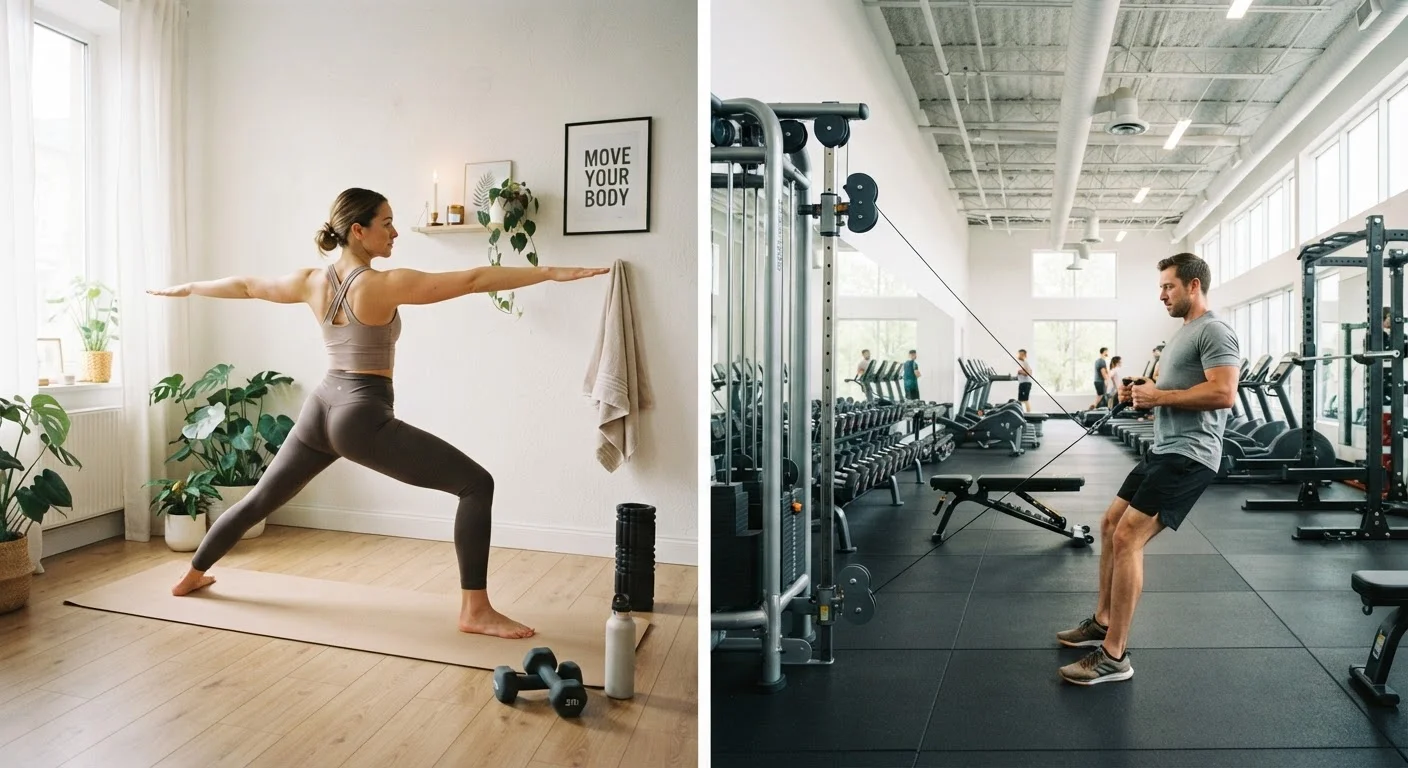
Photo: QuickSearches.net | It Doesn't Get Quicker Than This! editorial
Key Takeaways
- Home workouts cost less over time but require self-discipline and creative programming.
- Gyms provide equipment variety and social accountability that many people find motivating.
- Consistency matters more than location - the environment you'll actually use is the right one.
- Hybrid approaches combining both settings work well for many fitness goals.
- Budget, schedule, and fitness goals are the three most important factors when choosing.
The Real Question Behind the Debate
The home-vs-gym debate rarely has a clean winner - and that's actually useful information. Both settings can produce meaningful fitness results. What differs is how well each environment aligns with your specific goals, life circumstances, and the psychological factors that keep you consistent.
Many fitness myths make people believe they need expensive equipment or a specific setting to get fit. The evidence doesn't support that. What research consistently does support is that exercise adherence - your ability to keep showing up - is the single most predictive factor in long-term results. Everything else is secondary.
With that principle in mind, this comparison helps you evaluate both environments honestly, across the dimensions that actually matter.
Cost and Financial Commitment
Cost is often the deciding factor for budget-conscious households. Home workouts require an upfront investment in basic equipment - a set of resistance bands, a few dumbbells, or a yoga mat - but carry no ongoing monthly expense. Gym memberships, by contrast, typically involve monthly dues that can range from modest community center fees to significantly higher rates at specialized facilities.
| Home Workouts | Gym Workouts | |
|---|---|---|
| Upfront Cost | Low to moderate (equipment purchase) | Low (membership sign-up fee) |
| Ongoing Cost | Minimal after initial setup | Monthly membership dues |
| Convenience | Very high - no travel required | Moderate - commute adds time |
| Equipment Variety | Limited by space and budget | Extensive in most facilities |
| Social Accountability | Self-directed only | Classes, trainers, and community |
| Privacy | Complete privacy | Shared public environment |
| Availability | 24/7, any day | Subject to hours and crowding |
| Best For | Busy schedules, budget goals | Advanced training, social motivation |
Over a multi-year period, even a low-cost gym membership can exceed the price of a well-equipped home setup. However, home equipment purchases can also escalate quickly if you're drawn toward treadmills, cable machines, or power racks. Setting a clear equipment budget before buying prevents overspending on gear you may not use regularly.
Convenience, Scheduling, and Time
Travel time to and from a gym is a hidden cost that rarely appears in membership calculations. For someone working a demanding schedule, that 20-minute round trip can be the difference between a workout happening and being skipped. Fitting exercise into a 9-to-5 life is genuinely easier when the workout space is steps away rather than a drive across town.
Home workouts win decisively on convenience. You can exercise at 5 a.m. without waking a household, squeeze in a session during a lunch break, or finish before the kids wake up. Gyms impose hours of operation, peak-time crowding at equipment, and commute demands that add friction to an already-difficult habit.
Reduce Friction to Build the Habit
Equipment Access and Training Variety
This is where gyms hold a clear structural advantage. A well-equipped facility offers barbells, cable machines, specialty cardio equipment, free weights across a full range, and often group fitness classes - all under one roof. For goals like powerlifting, Olympic lifting, or sport-specific conditioning, a home setup can't easily replicate that range without significant investment and space.
Home workouts do have more flexibility than many people realize. Bodyweight training, resistance bands, and adjustable dumbbells cover a wide spectrum of strength and conditioning goals for most general fitness objectives. Workout sequencing strategies apply equally in both settings - smart programming can compensate for equipment limitations.
For those pursuing advanced strength goals or training variety as a motivational tool, the gym's equipment depth is a meaningful advantage that's difficult to replicate at home without dedicated space and budget.
Motivation, Accountability, and Social Environment
Motivation is deeply personal, and your honest assessment of what drives you matters more than general advice. Many people find that the social atmosphere of a gym - seeing others train, working with a personal trainer, or attending a group class - provides accountability that's hard to manufacture alone at home.
Others find gym environments intimidating, socially draining, or simply inconvenient enough that they go infrequently. For these individuals, home workouts remove a psychological barrier and make consistency easier. All movement counts, and an environment that encourages frequent, lower-friction activity often outperforms a theoretically superior environment that you rarely visit.
A hybrid approach - training at home most days and visiting a gym once or twice weekly for equipment variety or group energy - is a practical middle ground many people find sustainable.
This article is for general informational purposes only and does not constitute medical or fitness advice. Consult a qualified healthcare or fitness professional before beginning any new exercise program, especially if you have existing health conditions.
The content on this site is provided for informational purposes only and should not be considered a substitute for professional advice. While we strive to provide accurate and up-to-date information, we make no guarantees regarding its completeness or accuracy. Always consult a qualified professional for advice specific to your circumstances before making any decisions