
Debt-to-Income Ratio: What It Means and Why Lenders Watch It Closely

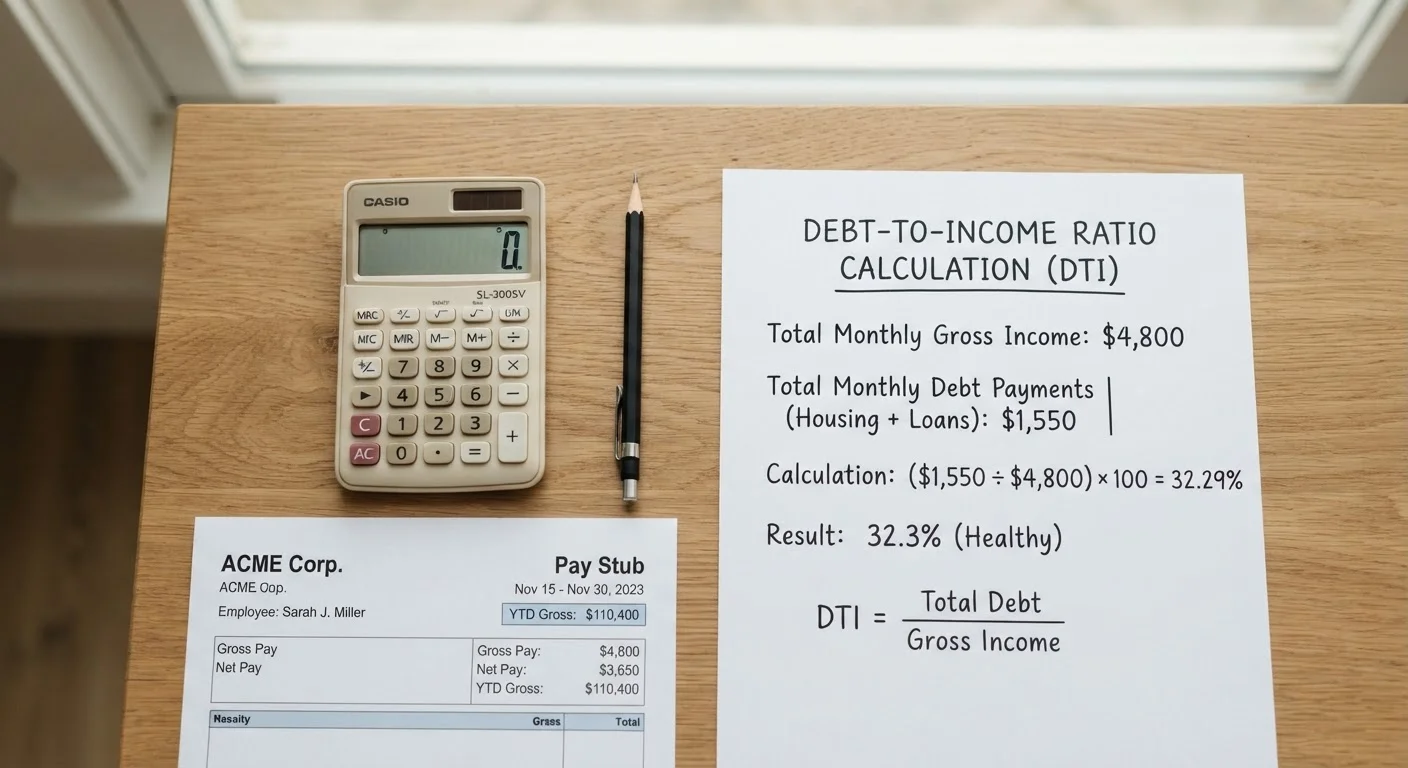
Photo: QuickSearches.net | It Doesn't Get Quicker Than This! editorial
Key Takeaways
- DTI is calculated by dividing total monthly debt payments by gross monthly income, expressed as a percentage.
- Most conventional mortgage lenders prefer a back-end DTI at or below 43%, though lower is better.
- A high DTI signals financial strain to lenders and can result in loan denial or higher interest rates.
- Paying down existing debt and increasing income are the two direct levers to lower your DTI.
- DTI measures debt burden, not creditworthiness - it works alongside, not instead of, your credit score.
How to Calculate Your DTI in Two Steps
The math is straightforward. Add up every required monthly debt payment - mortgage or rent, car loans, student loans, minimum credit card payments, and any other recurring loan obligations. Then divide that total by your gross monthly income (what you earn before taxes). Multiply by 100 to get a percentage.
Example: If you pay $1,800 in monthly debt obligations and earn $5,000 gross per month, your DTI is 36% ($1,800 ÷ $5,000 = 0.36).
Note what doesn't count: utilities, groceries, phone bills, and insurance premiums are not debt payments. Only contractual loan and credit obligations go into the numerator.
43%
Common maximum back-end DTI for qualified mortgages
The Consumer Financial Protection Bureau (CFPB) has identified 43% as a key threshold in qualified mortgage rules, though specific program limits vary.
36%
DTI level most lenders consider healthy
Many financial institutions and housing counselors cite 36% or below as a benchmark for manageable debt load relative to income.
28%
Recommended maximum for housing costs alone
Conventional lending guidelines have long suggested keeping housing-related debt (the front-end DTI) under 28% of gross monthly income.
Why Lenders Pay Close Attention to DTI
Lenders use DTI because it directly answers the question they care most about: can this person manage another payment on top of what they already owe? A credit score tells lenders how reliably you've paid bills in the past - as explained in our breakdown of what credit scores actually measure - but it says nothing about how much of your paycheck is already spoken for.
A borrower with a strong credit score but a DTI of 52% is carrying significant financial strain. If income drops or an unexpected expense hits, that person has little cushion. Lenders see that as elevated risk and respond accordingly - with higher rates, tighter terms, or outright denial.
For mortgages specifically, federal qualified mortgage rules have historically pointed to 43% as a meaningful back-end DTI threshold. Staying below it signals that a borrower has a reasonable margin between income and obligations. If you're preparing to buy a home, it's worth understanding how DTI interacts with other factors lenders review - including what's in your credit report.
Check Your DTI Before Applying for Any Loan
How to Reduce Your DTI
There are only two variables in the DTI equation: the debt you carry and the income you earn. Improving your ratio means moving one or both in the right direction.
- Pay off a loan or balance in full. Eliminating an entire payment has an outsized effect compared to just reducing a balance. A $300/month car loan you pay off removes $300 from your numerator immediately.
- Avoid taking on new debt before applying for credit. A new loan or a credit card balance adds to monthly obligations and raises DTI right before a lender checks it.
- Increase gross income. A raise, a part-time income source, or documented freelance work can lift the denominator. Lenders typically want to see consistent income rather than a one-time payment.
- Refinance at a lower rate. If market conditions and your credit profile allow, refinancing an existing loan at a lower rate can reduce the monthly payment figure, shrinking your DTI.
If your DTI is already elevated, it may be a sign worth taking seriously. Our guide on signs your debt load has become a financial risk can help you assess where you stand and what options exist.
DTI and the Bigger Financial Picture
DTI is a useful self-check even when you're not applying for credit. If more than 40 cents of every pre-tax dollar is going to debt payments, there isn't much room for saving, emergencies, or unexpected costs. That's a fragile financial position regardless of what a lender decides.
Think of DTI as a ratio that quantifies financial pressure. Keeping it low - ideally below 36% - means you have flexibility. That flexibility is what lets you handle a job disruption, an emergency repair, or a shift in income without immediately falling behind on obligations.
For readers dealing with serious debt levels, understanding the range of structured options available is an important next step. Our overview of debt settlement, debt management plans, and bankruptcy explains the distinctions in plain terms. And if you're approaching a home purchase, be aware that many buyers misread how both DTI and credit scores affect mortgage eligibility - a topic covered in common assumptions about credit scores and home loans.
This article is for general informational purposes only and does not constitute personalized financial or lending advice. Consult a licensed financial professional for guidance specific to your situation.
Frequently Asked Questions
The content on this site is provided for informational purposes only and should not be considered a substitute for professional advice. While we strive to provide accurate and up-to-date information, we make no guarantees regarding its completeness or accuracy. Always consult a qualified professional for advice specific to your circumstances before making any decisions