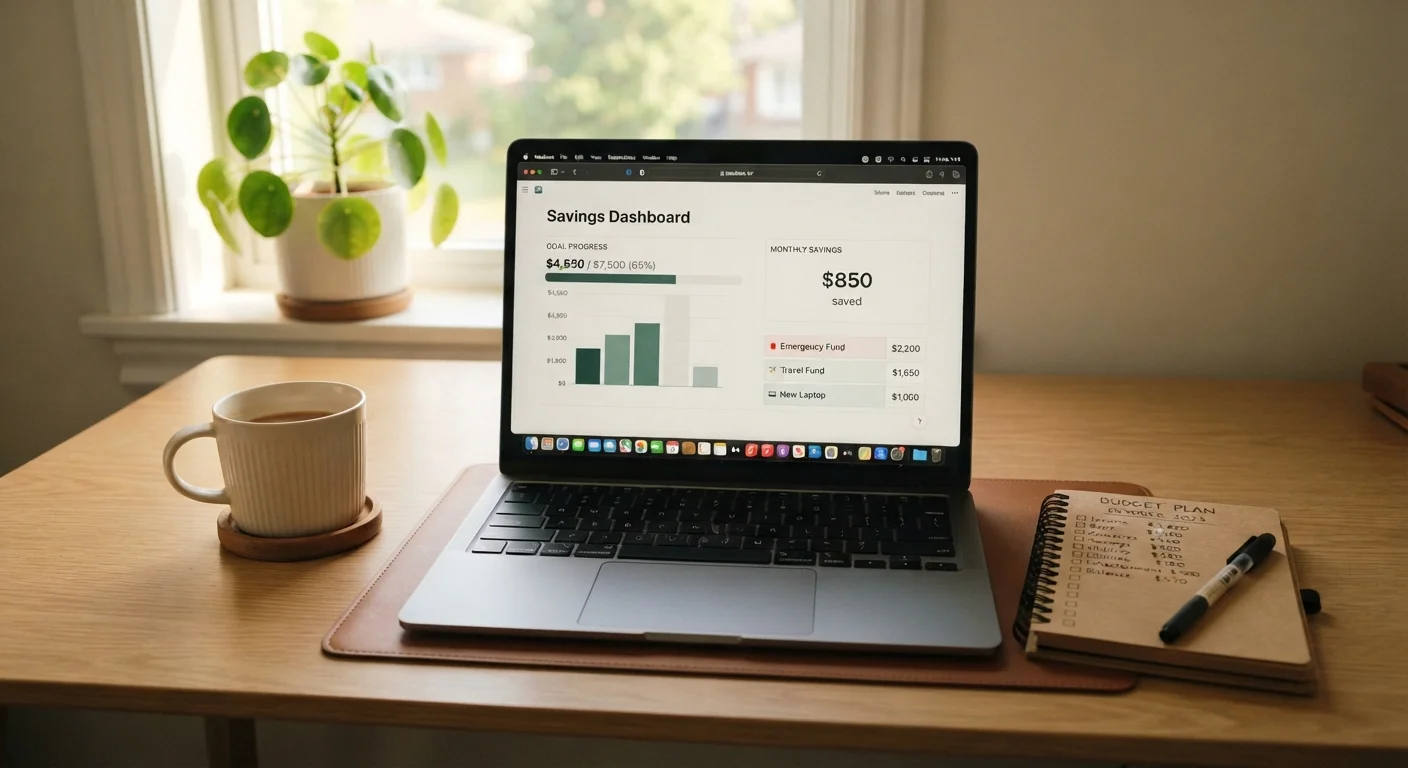
Explore how automated transfers, bill pay, and savings rules can remove decision fatigue and help money grow in the background.
Why Willpower Alone Doesn't Build a Savings Habit
Every budget starts with good intentions. The gap between intention and follow-through usually isn't discipline - it's design. When saving requires a conscious decision each month, it competes with dozens of other financial pressures for attention, and it often loses.
Research in behavioral economics consistently shows that people save more when saving is the default, not the exception. Automation converts a recurring decision into a one-time setup, which means the behavior keeps happening even on stressful months when everything else feels uncertain.
A solid personal budget is still the foundation - automation doesn't replace knowing where your money goes, it enforces the plan you've already made. The goal is to build systems that align your money's movement with your actual priorities, without relying on remembering to do it every single time.
Core Practices for Automating Your Finances
The following practices apply to most household financial situations, though the right amounts and sequencing depend on your specific income, expenses, and goals. Treat this as a framework to adapt, not a one-size prescription. For guidance on balancing saving and debt payoff, see saving and paying down debt at the same time.
1
Schedule savings transfers to go out on the same day as your paycheck.
Saving 'what's left over' at the end of the month rarely works because spending expands to fill available money. Moving savings immediately after income arrives treats it like a non-negotiable expense rather than an afterthought. This is the core principle behind 'pay yourself first,' which consistently outperforms willpower-based approaches.
Example: If your paycheck deposits every other Friday, set an automatic transfer to your savings account for the same day - even $25 or $50 builds a meaningful cushion over time.
2
Automate minimum debt payments and, where possible, a fixed extra amount above the minimum.
Missing debt payments damages your credit score and triggers fees. Automating at least the minimum eliminates that risk. Adding even a small fixed extra amount above the minimum accelerates payoff significantly due to how interest compounds - particularly on high-rate balances. See
how compound interest works against you for a plain-English explanation of why this matters.
Example: Automating a $25 extra monthly payment on a $3,000 credit card balance at 20% APR can cut months off repayment and reduce total interest paid.
3
Use separate, labeled savings accounts for different goals rather than one large pool.
Money lumped into a single savings account gets mentally spent on whatever feels urgent. Separate accounts - labeled 'Emergency Fund,' 'Car Repair,' 'Vacation' - make each goal concrete and harder to raid impulsively. Many banks allow multiple savings accounts with nicknames at no cost.
Managing multiple accounts without losing track covers practical ways to keep this organized.
Example: Set up three accounts: one for emergencies (target: three months of expenses), one for irregular predictable costs like car registration, and one for a specific near-term goal.
4
Enroll in employer-sponsored retirement contributions before setting up personal automation.
If your employer offers a matching contribution to a 401(k) or similar plan, contributing at least enough to capture that match is effectively a guaranteed return - something no savings account can replicate. This should be the first automated savings decision for anyone with access to it, as not capturing the match leaves compensation on the table.
Example: An employer matching 3% of salary on a $45,000 income equals $1,350 per year in free contributions - money that compounds over a working career.
5
Automate bill pay for fixed, recurring expenses and calendar variable ones.
Fixed bills - rent, insurance premiums, loan payments - are ideal for autopay because the amount doesn't change. Variable bills like utilities are better scheduled as calendar reminders to review and pay manually, since automating a variable amount can cause overdrafts if your balance is tight.
Understand how overdraft protection works before enabling autopay on any account with a thin balance.
Example: Set fixed rent and insurance to autopay, but put utility due dates on your phone calendar so you check the amount before it pulls.
6
Build a small cash buffer in your checking account before activating any automatic payments.
Automated payments fail - and generate fees - if your account runs short. A buffer of $100 to $200 sitting in checking acts as a margin of error against timing mismatches between income and outgoing payments. Without it, even a one-day payroll delay can cascade into multiple overdraft fees.
Example: Before turning on autopay for any bill, confirm your checking account carries enough idle cash to absorb a two-day delay in your paycheck without going negative.
Automation Is a Tool, Not a Set-and-Forget Fix
Automated systems still require periodic check-ins. Income changes, new expenses, and life events can throw off even a well-designed setup. Plan to review your automated transfers and bills at least once a quarter to make sure amounts and timing still reflect reality. Skipping these reviews is one of the most common reasons automation causes overdrafts or undersaving.
Start Here: Quick Wins You Can Set Up Today
The most effective automation setups aren't elaborate - they're consistent. Even one or two well-placed automatic transfers can shift your financial trajectory meaningfully over 12 months. Start with what's simplest and build from there rather than trying to automate everything at once.
high
Log into your bank today and schedule a recurring transfer of any fixed amount - even $20 - to a savings account timed to your next payday.
high
Enable autopay for the minimum payment on every credit card and loan you carry to protect your credit score from accidental missed payments.
high
Open one additional savings account labeled 'Emergency Fund' and direct any small automatic transfer to it until you reach one month of essential expenses.
high
Check your employer benefits portal this week to confirm whether a retirement match is available - and raise your contribution to capture it if not already doing so.
medium
Add your three most variable bill due dates (utilities, subscriptions) to your phone calendar so you review amounts before they're due.
If you prefer a more hands-on, structured approach to spending control alongside automation, the envelope system and its digital equivalents can complement automated savings by keeping discretionary spending in check.
This article provides general financial information for educational purposes and does not constitute personalized financial, investment, or tax advice. Consult a qualified financial professional before making decisions specific to your situation.
The content on this site is provided for informational purposes only and should not be considered a substitute for professional advice. While we strive to provide accurate and up-to-date information, we make no guarantees regarding its completeness or accuracy. Always consult a qualified professional for advice specific to your circumstances before making any decisions