
Common Myths About Building Home Equity

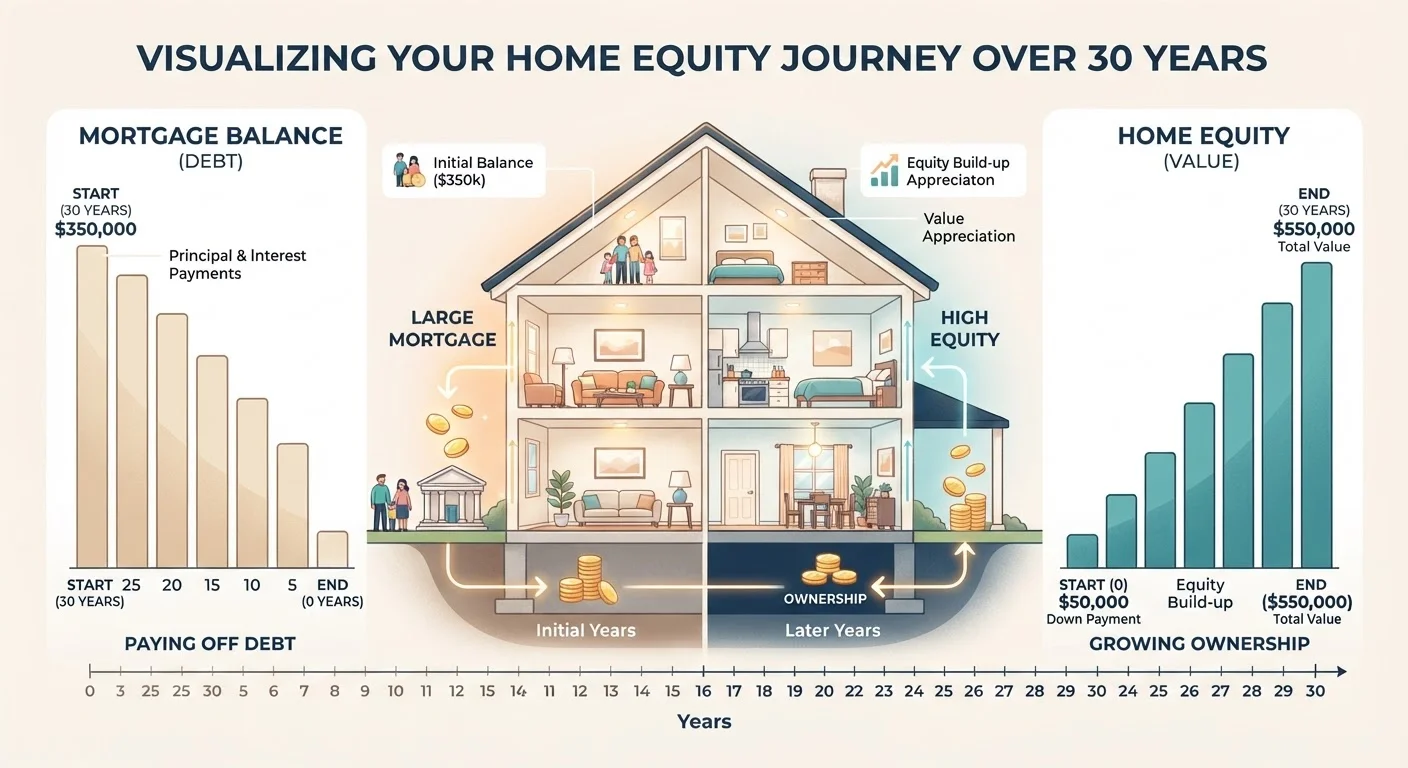
Photo: QuickSearches.net | It Doesn't Get Quicker Than This! editorial
Key Takeaways
- Early mortgage payments go mostly toward interest, not equity - amortization schedules make this clear.
- Home appreciation is not guaranteed and varies significantly by location, condition, and market cycle.
- Renovations rarely return 100% of their cost in added equity; returns depend heavily on project type.
- Making extra principal payments is one of the most reliable ways to accelerate equity growth.
- Equity is a long-term asset - treating it like short-term savings can create financial risk.
Why Equity Myths Are Costly for New Homeowners
Home equity - the portion of your property's value that you actually own outright - is one of the most cited reasons Americans pursue homeownership. But many new buyers carry significant misconceptions about how quickly equity accumulates, what drives it, and how reliably it grows. Acting on those misconceptions can lead to poor financial decisions, from over-borrowing against a home to skipping essential maintenance thinking appreciation will cover it.
The myths below are common, persistent, and worth correcting before they shape your financial strategy. For a broader look at how financial misconceptions can hold people back, see common budgeting myths that affect everyday planning.
Myth
Your monthly mortgage payment steadily builds equity from day one.
Fact
In the early years of a standard mortgage, the vast majority of each payment covers interest - not principal.
This is one of the most startling realities of how mortgages are structured. Under a standard amortizing loan, payments are front-loaded with interest. On a 30-year fixed mortgage, roughly 80-90% of your first few years of payments may go toward interest rather than reducing the principal balance. Equity from paydown grows slowly at first and accelerates only in the later years of the loan. Reviewing your amortization schedule - which any lender is required to provide - makes this concrete.
Myth
Home values always go up, so equity always grows over time.
Fact
Home values can stagnate or decline depending on local market conditions, economic cycles, and property condition.
The 2008 housing crisis is the most prominent U.S. example of widespread home value decline, but regional downturns happen regularly even in otherwise stable national markets. Appreciation is not a law - it is an outcome influenced by job markets, interest rates, neighborhood trends, and supply-and-demand dynamics that vary enormously by geography. Counting on appreciation as your primary equity-building strategy introduces meaningful financial risk. Equity growth from principal paydown is more predictable than market appreciation alone.
Myth
Renovations always increase your home's value by at least as much as they cost.
Fact
Most renovations recoup only a fraction of their cost in resale value, and returns vary widely by project type.
Industry cost-vs-value research consistently shows that even popular projects - kitchen remodels, bathroom additions, room conversions - rarely return 100% of their cost at resale. Midrange kitchen remodels have historically recouped somewhere in the 60-80% range, and high-end renovations often recover even less. Some improvements, particularly those that over-customize a home for personal taste, can actually narrow your buyer pool and reduce resale appeal. Renovations have real value for livability, but they should not be mistaken for reliable equity generators.
Myth
Once you have equity, it's safe to borrow against it freely.
Fact
Borrowing against home equity puts your property at risk if you cannot repay - your home is the collateral.
Home equity loans and home equity lines of credit (HELOCs) use your home as security. If you default on that borrowing, you can lose the home. Beyond default risk, drawing down equity reduces the financial cushion that equity provides, and if property values fall after you borrow, you can end up owing more than the home is worth. Equity is a long-term asset best treated with caution, not as an accessible savings account. Anyone considering tapping home equity should consult a financial adviser to understand the full risk picture.
Myth
Paying the minimum mortgage payment is fine - equity will build on its own.
Fact
Minimum payments are the slowest path to equity; additional principal contributions can accelerate the timeline significantly.
Because of amortization front-loading, sticking strictly to minimum payments means most of your money goes to the lender in interest for many years. Homeowners who make even modest additional principal payments - say, one extra monthly payment per year - can shave years off their loan term and build equity faster. This isn't about paying more than you can afford; even small, consistent additions to the principal make a measurable difference over a 30-year horizon. Always confirm with your lender that extra payments are applied to principal, not credited toward future interest.
Strategies That Actually Build Equity - and Ones That Don't
Understanding the myths is only half the picture. Knowing which actions genuinely move the needle on equity helps homeowners make smarter choices with their money.
~80%
Interest share of early mortgage payments
On a typical 30-year fixed mortgage, roughly 80% or more of initial monthly payments go toward interest rather than reducing principal balance.
60-80%
Average cost recouped by kitchen remodels
Remodeling industry data has consistently shown that midrange kitchen renovations recoup approximately 60-80% of their cost in resale value - rarely dollar-for-dollar.
30 years
Standard mortgage term in the U.S.
The 30-year fixed-rate mortgage remains the most common home loan structure in America, and its long amortization timeline directly affects how slowly equity builds in early years.
Extra principal payments are among the most direct tools available. Even one or two additional payments per year can meaningfully shorten your loan term and reduce the total interest paid. Many lenders accept additional principal payments without penalty - but always confirm your loan terms, and consider consulting a financial professional before restructuring any payment plan.
Targeted maintenance and improvements protect existing value rather than creating dramatic new equity. Keeping a roof sound, HVAC systems functional, and plumbing up to code prevents depreciation - which is equity preservation, not equity creation. The Home Improvement hub covers practical guidance on repairs that protect your investment. When evaluating renovation choices, avoid the myth that all updates pay off equally - as the flooring section illustrates in flooring myths homeowners commonly believe.
Equity also interacts with your broader credit and borrowing profile. Before tapping home equity through a line of credit or refinance, it's worth understanding how lenders evaluate your financial picture - including the role your credit score plays, as explained in common credit score assumptions that affect home loans.
Home Equity Is Not a Liquid Emergency Fund
This article is for general informational and educational purposes only and does not constitute financial, legal, or investment advice. Consult a qualified financial professional before making decisions about your mortgage, home equity, or property investments.
The content on this site is provided for informational purposes only and should not be considered a substitute for professional advice. While we strive to provide accurate and up-to-date information, we make no guarantees regarding its completeness or accuracy. Always consult a qualified professional for advice specific to your circumstances before making any decisions