
Understanding Compound Interest: The Force Working For or Against You

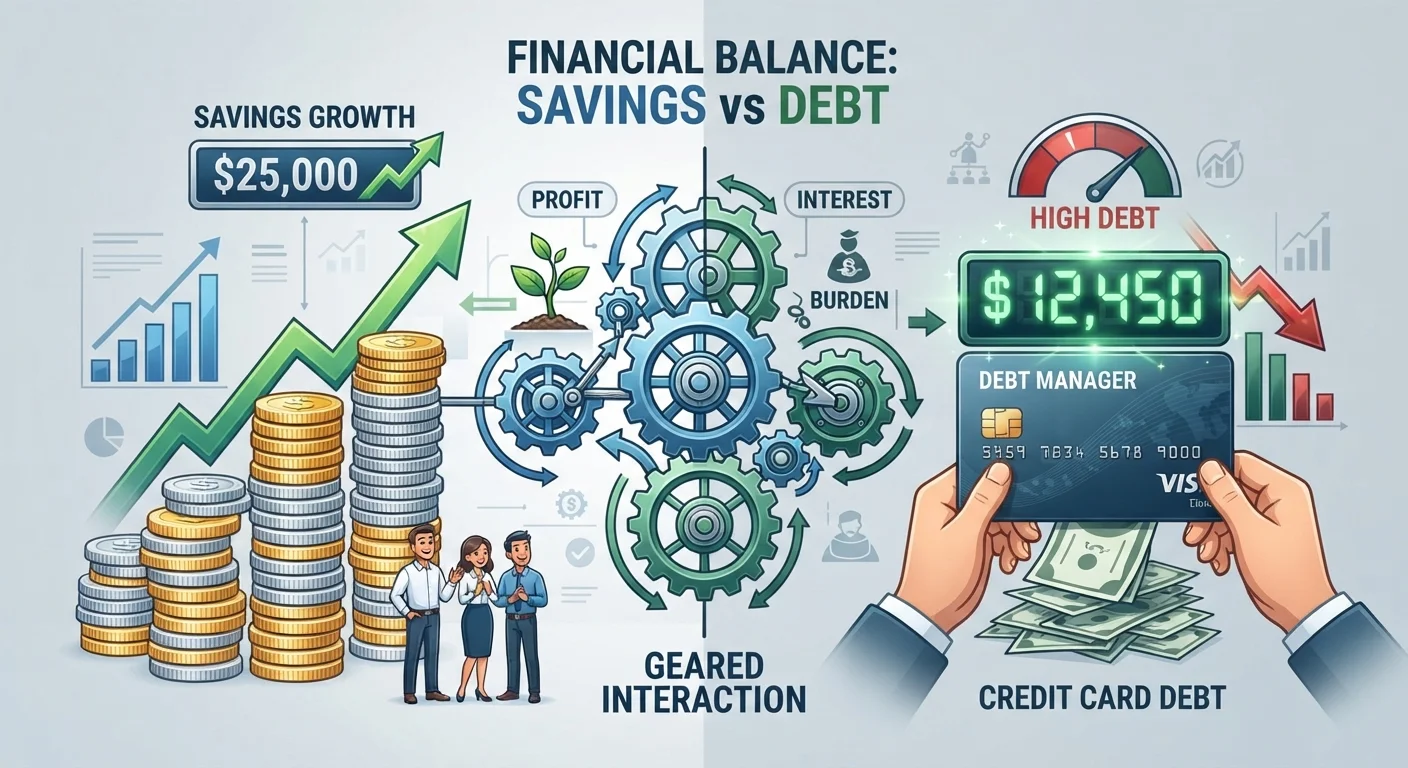
Photo: QuickSearches.net | It Doesn't Get Quicker Than This! editorial
Key Takeaways
- Compound interest earns you interest on your interest, not just your original deposit.
- The longer your money sits untouched in a savings account, the more powerful compounding becomes.
- High-interest debt - especially credit cards - uses the same mechanism against you.
- Starting earlier matters far more than starting with a larger amount.
- Paying only the minimum on debt keeps you trapped in compounding's negative cycle.
How Compound Interest Actually Works
Think of compound interest as a loop. You deposit $1,000 into a savings account earning 5% annual interest. After one year, you've earned $50 - so your balance becomes $1,050. In year two, you earn 5% on $1,050, not just the original $1,000. That's $52.50. By year three, you're earning interest on $1,102.50.
This doesn't sound dramatic at first. But give it a decade, and that original $1,000 becomes roughly $1,629 without you adding another dollar. Give it 30 years, and it approaches $4,322. The money grows faster as the balance grows - that's the loop.
The key variables that control how powerful this effect becomes are: the interest rate, how often interest compounds, and how much time passes. Of those three, time is the most accessible lever for most people.
“Compound interest is the eighth wonder of the world. He who understands it, earns it; he who doesn't, pays it.”
— Widely attributed to Albert Einstein, This quote, though its true origin is debated by historians, has long been used in financial education to illustrate compounding's dual nature
When Compounding Works Against You: Debt
The exact same math that grows your savings will grow your debt if you let it. Credit cards are the most common example. If you carry a $3,000 balance on a card with an 20% APR and only pay the minimum each month, you're not just paying interest on that $3,000 - you're paying interest on unpaid interest that has been added to your balance.
Minimum payments are designed to keep you in this cycle. A significant portion of each payment goes toward interest charges rather than reducing the principal. That's why a $3,000 balance paid at minimums can take well over a decade to clear and cost thousands in interest charges beyond the original amount borrowed.
The same dynamic applies to payday loans, certain personal loans, and any debt where interest accrues on an unpaid balance. The antidote is paying more than the minimum - ideally targeting the highest-rate debt first. See debt payoff strategies that can help you choose the right approach.
20%+
Average credit card APR in the U.S.
According to Federal Reserve consumer credit data, average credit card interest rates have exceeded 20% in recent reporting periods, making carried balances extremely costly over time.
~$1,629
$1,000 grows after 10 years at 5% compounded annually
This figure illustrates how compounding builds value without additional contributions, based on standard compound interest calculations.
3-in-10
Americans who carry a credit card balance monthly
Consumer Financial Protection Bureau research indicates a significant share of U.S. cardholders carry balances month-to-month, leaving them exposed to compounding interest charges.
Time Is the Variable You Control Most
A common misconception is that you need a large sum to benefit from compounding. You don't - you need time. Consider two people: one starts saving $100 per month at age 25 and stops at 35 (10 years of contributions). The other starts at 35 and contributes $100 per month until age 65 (30 years of contributions). Assuming identical interest rates, the person who started earlier often ends up with a comparable or larger balance despite contributing far less money - because their money had more time to compound.
This isn't financial advice tailored to your situation - it's an illustration of how the math works. The practical implication: even a modest, consistent savings habit started today is worth more than a larger effort delayed. Automating small transfers is one low-friction way to put this into practice.
Where you park your savings also matters. Checking and savings accounts differ significantly in how - and whether - they pay interest at all. A checking account typically earns little to nothing, while a high-yield savings account can meaningfully accelerate compounding on the same balance.
Check Your Account's Compounding Frequency
Putting It Together: The Balanced Approach
Compound interest creates a genuine tension for anyone carrying high-interest debt while also trying to save. Every dollar sitting in a savings account earning 4% is a dollar not reducing a credit card balance costing you 20%. The math usually favors paying down high-rate debt aggressively before prioritizing savings beyond a basic emergency fund.
That said, completely ignoring savings to attack debt carries its own risk - an unexpected expense becomes the next debt. Finding the right balance depends on your specific interest rates, income stability, and how much cushion you have.
The most important thing to understand is that compound interest is not a passive background concept - it's actively working on your balance every day in one direction or another. Being intentional about which direction that is makes a concrete difference to your financial position over time.
This article provides general financial education and is not personalized financial advice. For guidance specific to your circumstances, consider consulting a licensed financial professional.
Frequently Asked Questions
The content on this site is provided for informational purposes only and should not be considered a substitute for professional advice. While we strive to provide accurate and up-to-date information, we make no guarantees regarding its completeness or accuracy. Always consult a qualified professional for advice specific to your circumstances before making any decisions