
Minimum Payments vs. Aggressive Payoff: The True Cost of Carrying Credit Card Debt

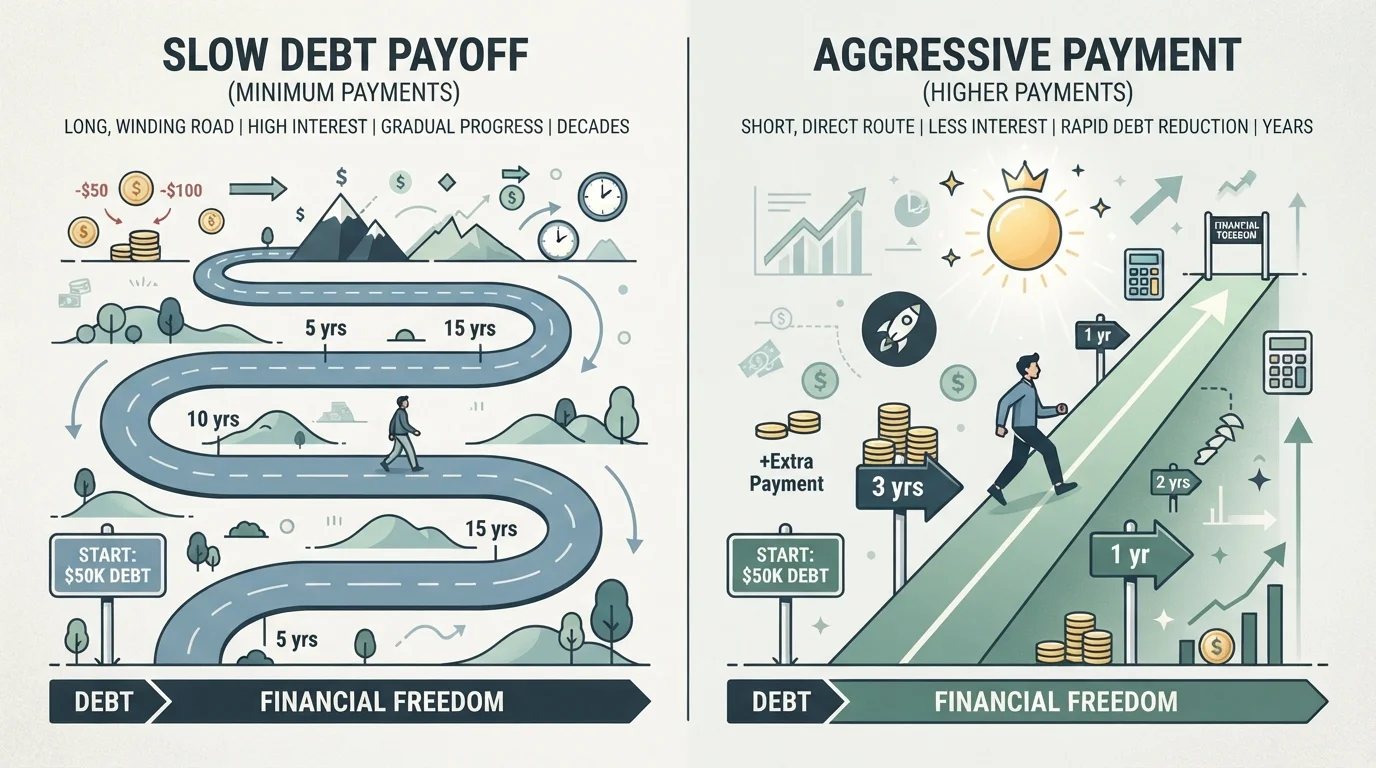
Photo: QuickSearches.net | It Doesn't Get Quicker Than This! editorial
Key Takeaways
- Making only minimum payments can extend a credit card balance for a decade or more and nearly double the total cost.
- Even modest increases above the minimum payment dramatically reduce both the payoff timeline and total interest paid.
- Credit card interest compounds daily on most accounts, meaning every extra dollar paid now saves more than a dollar later.
- Aggressive payoff frees up cash flow and improves your credit utilization ratio over time.
- There is no single right approach - your income, emergency savings, and other debts all factor into the smartest strategy.
How Minimum Payments Are Calculated - and Why They Keep You in Debt
Credit card issuers typically set your minimum payment as either a flat dollar amount (often $25-$35) or a small percentage of your outstanding balance - commonly 1% to 2% - whichever is greater. That sounds manageable, but there's a catch: as your balance falls, so does your minimum payment. The result is a system that's structurally designed to extend repayment as long as possible.
On a $5,000 balance at a 20% annual percentage rate (APR), paying only the minimum each month could take over 18 years to pay off and cost more than $6,000 in interest alone - meaning you'd pay well above double the original balance. Federal law requires issuers to disclose this on your statement, but many cardholders never look closely at those numbers.
Interest on most credit cards compounds daily. The issuer divides your APR by 365 to get a daily periodic rate, then applies it to your average daily balance. That compounding effect is why carrying a balance is so costly, and why even small reductions in your principal have an outsized benefit over time.
What Aggressive Payoff Actually Looks Like
Aggressive payoff doesn't mean you need to make heroic sacrifices - it means committing to a fixed monthly payment that's meaningfully higher than the minimum and keeping it there even as your balance drops. This breaks the trap of shrinking minimums.
| Minimum Payments Only | Fixed $150/Month | Fixed $300/Month | |
|---|---|---|---|
| Starting Balance | $5,000 | $5,000 | $5,000 |
| APR Assumed | 20% | 20% | 20% |
| Estimated Payoff Time | 18+ years | ~40 months | ~20 months |
| Total Interest Paid | ~$6,000+ | ~$1,800 | ~$900 |
| Total Amount Paid | ~$11,000+ | ~$6,800 | ~$5,900 |
| Monthly Budget Impact | Lowest (shrinking) | Moderate, predictable | Higher, predictable |
| Credit Utilization Improvement | Very slow | Gradual | Fast |
Using the same $5,000 balance at 20% APR as a benchmark: paying $150 per month (roughly three times a typical minimum) cuts the payoff timeline to about 40 months and reduces total interest to around $1,800 - a saving of more than $4,000 compared with minimum-only payments. Doubling that to $300 per month clears the debt in under 20 months with under $900 in interest.
The math reinforces a simple principle: the faster you reduce principal, the less interest accrues. For structured strategies to tackle multiple accounts at once, see the debt avalanche vs. debt snowball comparison for a breakdown of two proven approaches.
Fix Your Payment Amount, Not Just the Percentage
The Hidden Costs Beyond Interest
Carrying a large credit card balance doesn't only cost you in interest charges - it affects other parts of your financial life in ways that compound the damage.
- Credit utilization: Bureaus calculate your utilization ratio (balance divided by credit limit) as a major factor in your credit score. A high ratio can lower your score, which in turn raises borrowing costs elsewhere. Keeping a $5,000 balance on a $6,000 limit card puts your utilization at over 83% - well above the commonly recommended threshold of 30%. You can learn more about how these patterns affect you in this look at habits that quietly damage credit scores over time.
- Opportunity cost: Every dollar going toward interest is a dollar not building savings, investing, or covering other needs. When that credit card debt is finally gone, those monthly payments become available cash.
- Loan pricing: A lower credit score from high utilization and carrying debt affects loan rates far beyond credit cards - including auto and mortgage financing. Your credit score can change the car deal more than the sticker price, making this a real downstream cost.
When Minimum Payments Make Sense - and When They Don't
There are situations where paying only the minimum is the rational short-term choice: if you've just lost income, if paying more would leave you unable to cover rent or groceries, or if you're directing extra cash toward building a small emergency fund first. Carrying a balance is expensive, but missing rent or dipping into a zero-balance emergency fund to pay credit card debt can create a worse cycle.
That said, minimum payments should be a temporary position - not a default setting. The moment your cash flow allows more, increasing that monthly payment has an immediate and compounding effect. Even an extra $50 per month above the minimum can shave years off a typical balance.
If you're weighing whether to pay down debt or save simultaneously, a structured approach helps. The decision involves your APR, your income stability, and whether you have any savings buffer at all - a topic covered in detail in this guide to saving and paying down debt at the same time. And if your debt situation has grown severe, understanding the difference between options like settlement and debt management plans is worth your time - see debt settlement, debt management plans, and bankruptcy for a plain-language overview.
This article is for general informational and educational purposes only and does not constitute personalized financial advice. Consult a qualified financial professional for guidance specific to your situation.
The content on this site is provided for informational purposes only and should not be considered a substitute for professional advice. While we strive to provide accurate and up-to-date information, we make no guarantees regarding its completeness or accuracy. Always consult a qualified professional for advice specific to your circumstances before making any decisions