
Hands-Free vs. No Phone: What the Research Says About Distracted Driving

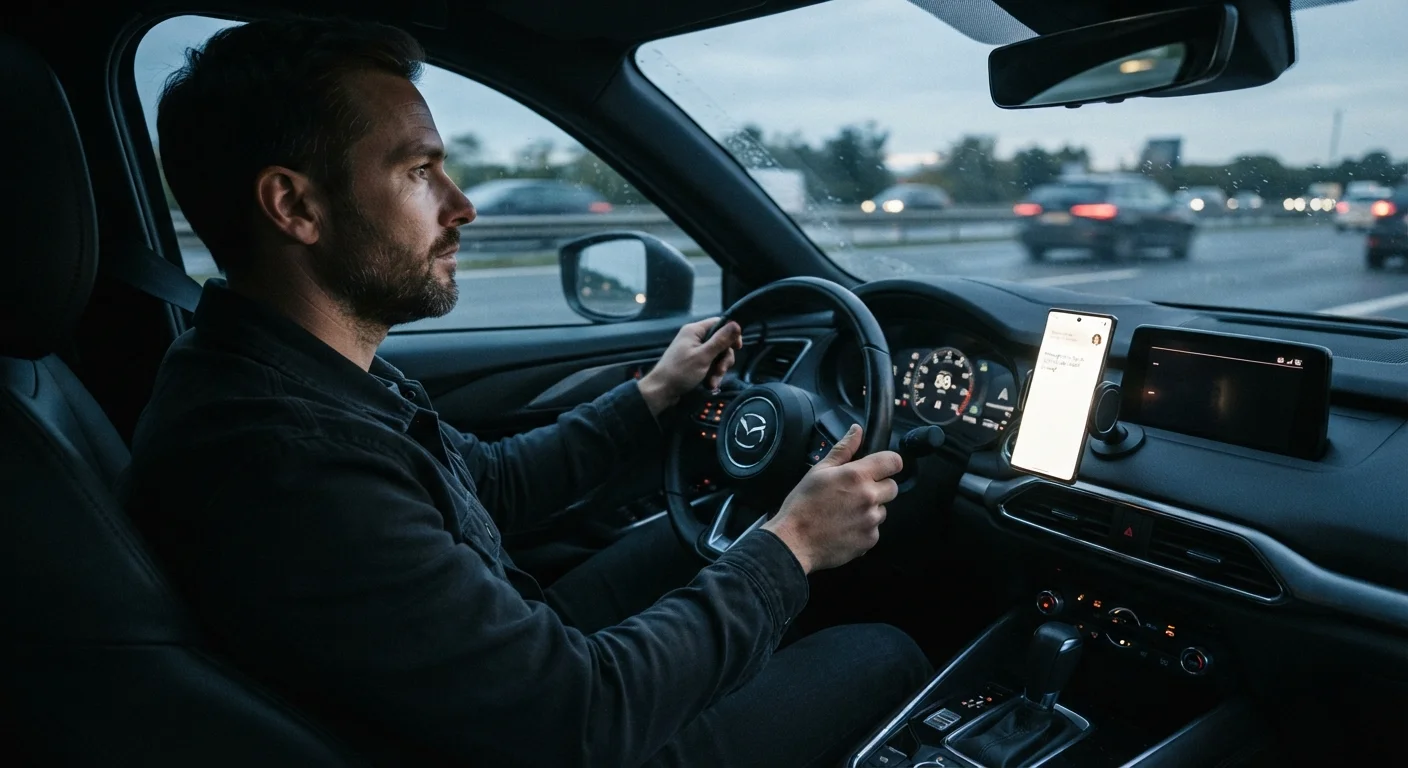
Photo: QuickSearches.net | It Doesn't Get Quicker Than This! editorial
Key Takeaways
- Hands-free phone calls still significantly impair driving performance compared to no phone use.
- Cognitive distraction - not just physical distraction - is the primary danger of phone use while driving.
- Crash risk during a phone conversation is estimated to be roughly four times higher than undistracted driving.
- Voice-activated systems and Bluetooth do not eliminate the mental workload that causes dangerous inattention.
- Completing a call before driving or pulling over safely remains the most effective risk-reduction strategy.
Why Hands-Free Feels Safe - But Often Isn't
For most drivers, the logic seems airtight: if both hands are on the wheel and eyes are on the road, a phone call can't be that dangerous. Hands-free technology was designed specifically to address the risk of holding a phone, and laws in many states reflect this reasoning by banning handheld use while permitting Bluetooth or speakerphone calls.
The problem is that this framework focuses on the wrong kind of distraction. Research from the National Safety Council and multiple university studies identifies three types of distraction: visual (eyes off the road), manual (hands off the wheel), and cognitive (mind off the task of driving). Hands-free devices largely eliminate the first two but do almost nothing about the third - and cognitive distraction turns out to be the most consequential of all.
When a driver is engaged in a phone conversation, brain imaging research shows measurably reduced activity in the regions responsible for processing visual information - even while their eyes remain open and pointed at the road. Drivers in this state look but don't fully register what they see, a phenomenon sometimes called inattention blindness.
Myth
Hands-free calls are safe because your hands stay on the wheel and your eyes stay on the road.
Fact
Hands-free calls significantly impair driving through cognitive distraction, even without any physical phone handling.
Safety research distinguishes between manual, visual, and cognitive distraction. Hands-free devices address only the first two. The mental effort of holding a conversation reduces the brain's capacity to process the driving environment, slowing reaction times and narrowing the driver's effective field of attention.
Myth
Talking to a passenger is just as distracting as talking on the phone.
Fact
Passenger conversations are demonstrably less impairing than phone calls in controlled driving studies.
Passengers share the driver's situation - they can see hazards, naturally pause mid-sentence, and reduce conversational demands when traffic becomes complex. A remote caller has no awareness of road conditions and makes no such accommodations, placing consistent cognitive demands on the driver regardless of what's happening outside.
Myth
Only texting while driving is truly dangerous - a quick call is fine.
Fact
Voice calls, handheld and hands-free alike, are associated with crash risk roughly four times that of undistracted driving.
Texting is uniquely dangerous because it involves all three distraction types simultaneously, but phone calls are far from benign. Cognitive impairment from a conversation degrades hazard response, lane tracking, and speed management in ways that crash statistics confirm - even when no screen is ever touched.
Myth
If a hands-free call were really dangerous, it would already be illegal everywhere.
Fact
Laws lag behind research; many state statutes ban handheld use but permit hands-free calls despite similar cognitive risk profiles.
Legislation often reflects what is politically and practically enforceable, not the full weight of scientific evidence. The fact that something is legal does not mean it is safe. Traffic safety researchers and organizations such as the National Safety Council have advocated for broader bans, but driver behavior is ultimately a personal decision within existing law.
Myth
Experienced drivers can handle phone conversations because they're better at multitasking.
Fact
Driving experience does not meaningfully offset the cognitive impairment caused by phone conversations.
While experienced drivers do automate certain lower-level vehicle control tasks, the cognitive bottleneck created by a phone call affects higher-order processing - hazard anticipation, situation awareness, and decision-making - regardless of how many years someone has been behind the wheel. No amount of practice eliminates inattention blindness.
What Crash Data Actually Shows
The most widely cited figure in distracted driving research comes from studies using naturalistic driving data and simulator experiments: drivers talking on a cell phone - handheld or hands-free - face roughly four times the crash risk of undistracted drivers. That figure is comparable to driving at the legal limit for blood alcohol content in most U.S. states.
4x
Increased crash risk during phone calls
Multiple peer-reviewed studies using naturalistic driving data estimate that cell phone use - handheld or hands-free - quadruples crash risk compared to undistracted driving.
27 sec
Mental recovery time after voice-assistant task
Research from the AAA Foundation for Traffic Safety found that driver attention can remain impaired for up to 27 seconds after completing a voice-based interaction with an in-vehicle system.
37%
Reduction in brain activity processing the visual scene
Neuroimaging studies have found that engaging in a phone conversation while driving reduces activity in parietal regions associated with spatial processing by roughly a third.
Importantly, several large studies have found that hands-free and handheld calls produce similar impairment levels when measured by reaction time, lane-keeping, and hazard detection. The physical act of holding the phone is a risk, but removing it does not remove the cognitive load of maintaining a two-way conversation with someone who cannot see or adapt to traffic conditions the way a passenger can.
This is a key distinction: research consistently shows that conversations with passengers are less impairing than phone calls. Passengers naturally pause, point out hazards, and adjust their conversational demands to the road environment. Remote callers cannot.
For drivers who rely on advanced driver-assistance systems, it is worth noting that those features are not a substitute for full attention - as covered in our look at what your car's safety systems can and cannot do.
Reducing Your Risk Behind the Wheel
Understanding the research doesn't require giving up your phone permanently - it requires being realistic about when and how you use it. A few practical principles are supported by the evidence:
- Finish calls before you drive. If a conversation is important, complete it while parked. Most calls can wait five minutes.
- Pull over safely if a call can't wait. This eliminates both manual and cognitive distraction simultaneously.
- Use Do Not Disturb driving modes. Most smartphones offer settings that suppress notifications and auto-reply to messages while the vehicle is in motion - enabling these reduces temptation without requiring willpower in the moment.
- Be skeptical of voice-assistant multitasking. Dictating a text or asking a navigation app a question still pulls cognitive resources away from driving. Studies have found that voice-based interactions with in-car systems can take up to 27 seconds of mental recovery time after the task is complete.
The broader goal of reducing screen-driven mental overload - explored in detail in our article on digital habits and cognitive load - applies with heightened urgency when you're operating a vehicle.
No Call Is Worth the Risk
The content on this site is provided for informational purposes only and should not be considered a substitute for professional advice. While we strive to provide accurate and up-to-date information, we make no guarantees regarding its completeness or accuracy. Always consult a qualified professional for advice specific to your circumstances before making any decisions