
Everything on Your Phone Bill, Line by Line

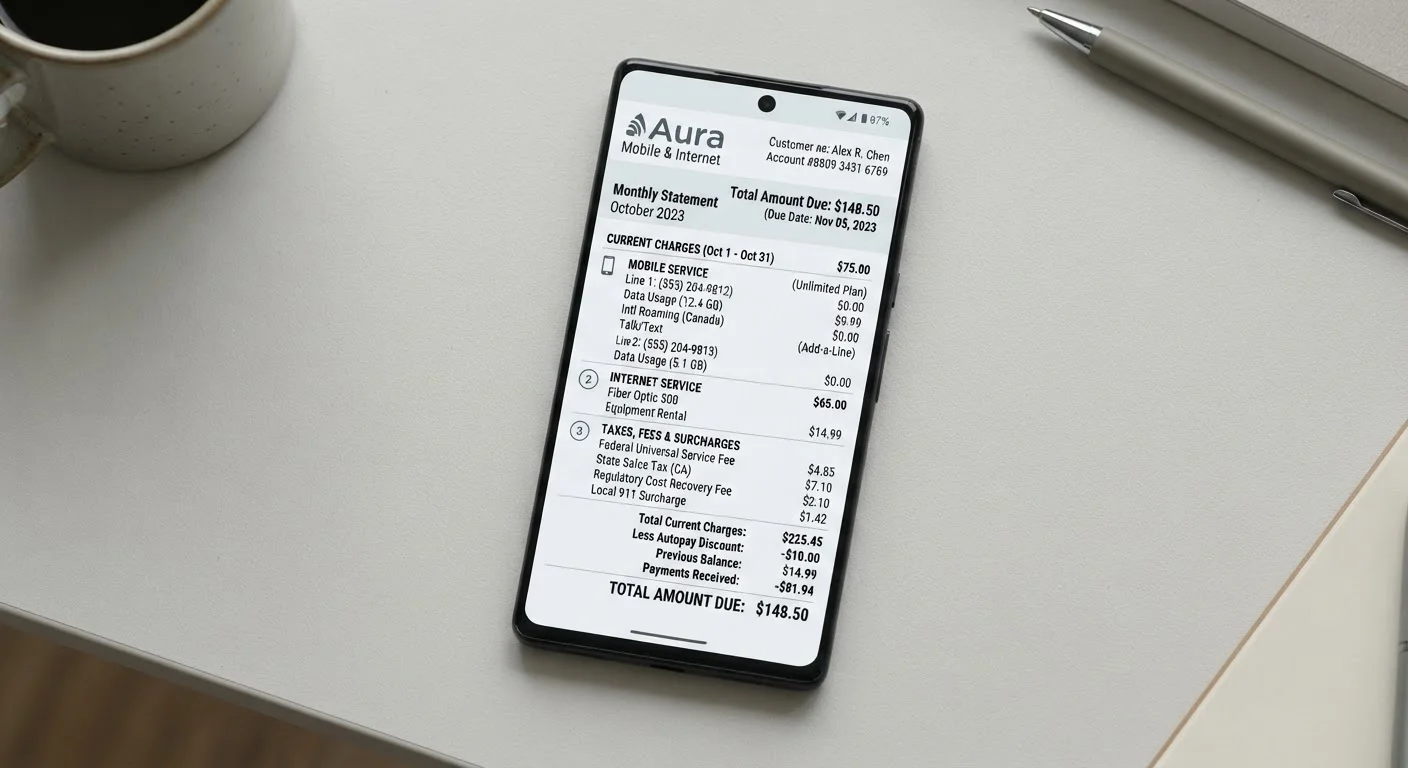
Photo: QuickSearches.net | It Doesn't Get Quicker Than This! editorial
The Anatomy of a U.S. Wireless Bill
Open a typical U.S. wireless bill and you'll often find the advertised plan price is only the starting point. Carriers break charges into several distinct buckets - base plan fees, device costs, government-mandated taxes, and carrier-imposed surcharges - and each category follows its own logic. Understanding the structure is the first step to knowing whether what you're paying is legitimate or worth disputing.
| Typical base plan advertised price | Starting point only - taxes and fees add 10%-30% in most markets (General industry pattern; varies by carrier and location) |
| Federal Excise Tax rate | 3% on local telephone service charges (U.S. federal law) |
| USF contribution rate | Fluctuates quarterly; set by FCC calculation (FCC Universal Service Administrative Company (USAC)) |
| Common E911 fee range | $0.50-$3.00 per line per month (Varies by state and locality) |
| Autopay discount per line | Typically $5-$10 per line, per month (General carrier practice; confirm with your specific carrier) |
| Carrier administrative fee (typical) | $1.50-$3.00 per line per month (Carrier-set; not a government fee) |
For a deeper look at how carriers construct their pricing tiers before you sign up, see our phone plan shopping checklist so you can spot red flags early.
Base Plan and Per-Line Fees
The monthly plan fee is the figure advertised - unlimited talk, text, and data at a stated price. What carriers often don't lead with is the per-line fee, an additional monthly charge per device on your account. On a family plan with four lines, per-line fees of $10-$20 each can add $40-$80 before a single tax appears.
Also common:
- Autopay/paperless discount - Many carriers quote a price that assumes you enroll in autopay and paperless billing. If you don't, that discount disappears and your bill rises by $5-$10 per line.
- Device Payment (installment) charge - If you financed a phone through the carrier, a monthly installment appears here. This is separate from your service cost and continues until the device is paid off.
- Device protection plan - Optional insurance for damage, loss, or theft. Usually $10-$18/month per device.
Universal Service Fund (USF)
A federal program administered by the FCC that subsidizes telecommunications access for rural communities, schools, libraries, and low-income households. Carriers are required to contribute to it and typically pass a portion of this cost to consumers as a line item.
Per-line fee
A recurring monthly charge applied to each individual device or phone number on an account, separate from the base plan cost. On multi-line family accounts, these fees compound significantly.
Cramming
The practice of adding unauthorized or deceptive third-party charges to a consumer's wireless bill without clear consent. The FCC and FTC have both taken enforcement action against this practice; consumers can request a third-party charge block from their carrier.
Administrative fee
A carrier-determined surcharge, not a government tax, intended to offset the carrier's regulatory compliance costs. The carrier sets the amount and can change it without regulatory approval.
E911 fee
A state or locally mandated per-line fee collected to fund Enhanced 911 emergency dispatch systems, including location-tracking infrastructure. Rates vary by jurisdiction.
Device installment plan
A financing arrangement where the cost of a smartphone or device is split into monthly payments, typically over 24-36 months. This charge is separate from service costs and continues until the full device price is paid.
Government Taxes and Mandated Fees
Some charges on your bill are set by federal, state, or local law - carriers collect them and remit them to government agencies. These vary by location, which is why two people on the same plan in different states pay different totals.
- Federal Excise Tax (FET) - A 3% federal tax on local telephone service, established under federal law. It applies to local service charges, not necessarily the entire bill.
- State and local sales or use taxes - These range widely by jurisdiction, commonly between 4% and 10% of taxable charges.
- 911 / E911 fee - A per-line monthly charge (often $0.50-$3.00) that funds emergency dispatch infrastructure, set by state or local government.
- Universal Service Fund (USF) contribution - The FCC requires carriers to contribute to the USF, which subsidizes phone service in rural areas and for low-income households. Carriers typically pass this cost to consumers as a line item; the percentage fluctuates quarterly based on FCC calculations.
- State USF / Telecommunications Relay Service (TRS) fee - State-level equivalents that fund relay services for people with hearing or speech disabilities.
These charges are non-negotiable and cannot be waived. If you want to compare total costs across carriers, always ask for an estimate that includes all taxes and fees for your zip code.
Carrier-Imposed Surcharges (Not Government Fees)
This is where many consumers feel misled. Carriers add their own surcharges - separate from government taxes - that are often labeled in ways that imply they're mandatory government levies. They are not. They are business costs the carrier chooses to itemize rather than absorb into the plan price.
- Administrative fee / regulatory fee - A carrier-set charge, typically $1.50-$3.00 per line, that covers the carrier's internal cost of complying with regulations. The carrier sets this amount and can change it unilaterally.
- Network access fee / network surcharge - Funds network maintenance and expansion, per the carrier. Usually $1-$5 per line.
- Roaming surcharge - Applied if you used service in an area outside your carrier's native network, or internationally, without an add-on plan.
- Premium service charges - Third-party content or subscriptions (ringtones, apps, charity donations) sometimes added by third-party vendors through a process called cramming. If you see an unfamiliar charge here, you can dispute it with your carrier and request a crammer block.
For a side-by-side comparison of how these surcharges differ from home internet fees, see our breakdown of hidden ISP bill charges.
One-Time and Occasional Charges
Beyond recurring monthly items, wireless bills occasionally include one-time charges:
- Activation fee - Charged when adding a new line or device, typically $15-$35, though carriers sometimes waive it during promotions.
- SIM card fee - A one-time charge for a physical SIM card or eSIM provisioning.
- Early termination fee (ETF) - Less common since industry-wide shifts to month-to-month plans, but still appears if you exit a contract before its term ends. Device installment balances are different - those are owed regardless of whether service is terminated.
- Overage charges - On non-unlimited plans, charges for exceeding data, minutes, or text allotments.
- Late payment fee - Applied when payment is received after the due date.
Understanding every element of wireless billing is foundational to managing your overall connectivity costs. For the full picture - from choosing a plan to switching carriers - see our complete guide to wireless plans for U.S. consumers. You can also explore related guidance for your everyday devices.
The content on this site is provided for informational purposes only and should not be considered a substitute for professional advice. While we strive to provide accurate and up-to-date information, we make no guarantees regarding its completeness or accuracy. Always consult a qualified professional for advice specific to your circumstances before making any decisions